
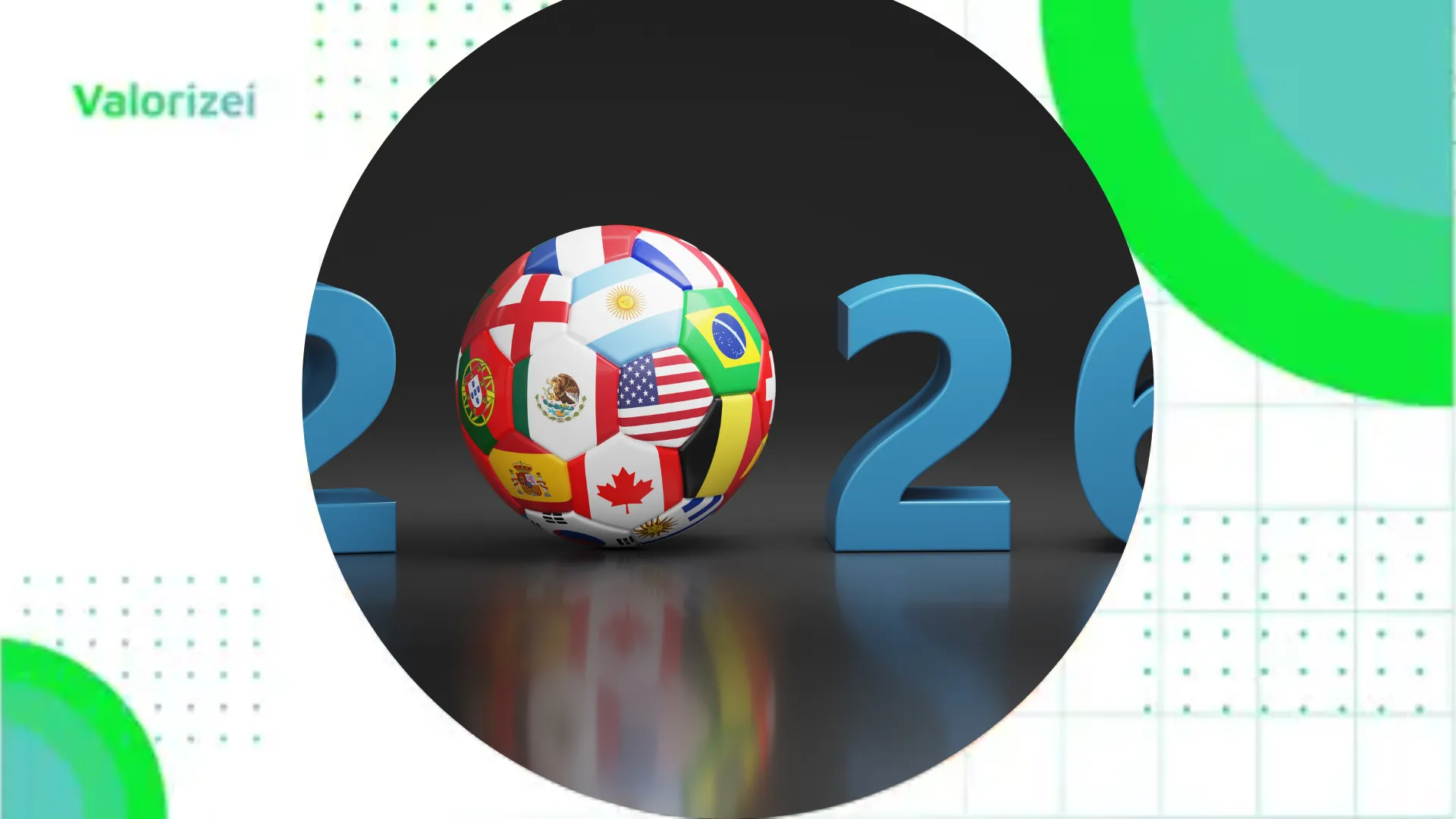
Investing in actions related to tourism and consumption During the 2026 World Cup, a thorough technical analysis is required.
Announcements
This tripartite mega-tournament, hosted in the United States, Mexico, and Canada, is reshaping the flow of short-term global capital.
Understanding the impacted supply chains differentiates the strategic investor from the common retail speculator.
The seasonality of this sporting event acts as a concentrated demand shock, generating positive distortions in multiple stocks listed on the B3 and on US stock exchanges.
We will analyze crucial sectors such as hospitality, air transport, beverages, payment methods, and high-performance sportswear.
The focus is on identifying assets with solid fundamentals capable of capturing this extra liquidity.
Table of Contents
- The Financial Dynamics of the Biggest Sporting Event
- Which tourism sectors capture the most value?
- How does mass consumption impact listed assets?
- Table of Economic Projections and Market Targets
- Frequently Asked Questions (FAQ)
The Financial Dynamics of the Biggest Sporting Event
The financial market prices in large-scale events well in advance, but the actual execution brings volatility and opportunities.
The expansion to 48 participating teams extended the game calendar, injecting billions of dollars directly into the real economy of North America.
The multiplier effect spreads globally through global value chains.
To analyze actions related to tourism and consumption It requires tracking where the new money from fans will actually be spent.
Consolidated banking projections indicate a multi-billion dollar increase in the Gross Domestic Product of the host countries.
This massive flow of international capital translates directly into net revenue for market-leading companies.
Airport infrastructure and hotel chains are operating at maximum occupancy, allowing for price increases and margin expansion.
Additionally, clothing brands and major breweries experience peak sales on a global scale during the months of the tournament.
Astute investors are using this macroeconomic catalyst to optimize their strategic equity portfolios.
Which tourism sectors capture the most value?
Airlines and accommodation booking platforms are the first to register a positive impact on their financial statements.
The volume of domestic and international flights in the tournament region is reaching successive historical records.
This scenario significantly increases the revenue per available seat for operating airlines.
Investors are looking for actions related to tourism and consumption Assessing companies' ability to manage volatile operating costs.
Aviation fuel prices require constant regulatory attention due to ongoing global geopolitical tensions.
Companies with good commodity risk management tend to retain a larger share of this seasonal extraordinary profit.
Traditional hotels and shared accommodation models are demonstrating exceptional financial resilience through high average daily rates.
Global hotel giants and digital platforms are taking advantage of the shortage of beds to maximize their operational profitability.
According to sector analyses published on the financial portal G1 EconomyThis segment leads in capturing gross margin.
How does mass consumption impact listed assets?
The retail trade of food, beverages, and sporting goods is experiencing strong acceleration in global sales amidst the competition.
Billions of glasses of beer are consumed globally, boosting the combined results of the world's largest manufacturers.
Official sponsorship of the event guarantees commercial exclusivity in highly profitable distribution channels.
Acquiring shares in these corporations requires an understanding of the dynamics of regional logistics distribution in emerging and developed markets.
The actions related to tourism and consumption Mass audiences react positively when teams from populous markets advance in the tournament.
This sporting advancement prolongs consumer engagement and sustains high sales for weeks.
Sporting goods companies profit through the global licensing of official uniforms and collectible themed products.
Direct sales to end consumers expand the operating revenue of physical retail chains and e-commerce platforms.
Investors should select companies with integrated supply chains and low levels of net debt.
+ Cryptocurrencies in 2026: are they worth it with more regulation?
Table of Economic Projections and Market Targets
Below, we present consolidated data on economic and financial projections for the tournament period, reflecting official macroeconomic estimates.
+ Passive income in dollars: Brazilians seek currency protection.
| Economic Sector | Global Movement Projection | Estimated Impact on Operating Margins |
| Tourism and Aviation | US$ 9.1 billion in direct revenue | Average increase of 3.5% in sectoral ROIC |
| Beverages (Breweries) | Consumption exceeding 1 billion cups | Expansion of 0.3% in global annual volume |
| Bars and Restaurants (BR) | R$ 2.42 billion in revenue | Real growth of 15.71% compared to 2022. |
| Retail and Sporting Goods | US$ 4.1 billion in licenses | Increase in direct sales via e-commerce |
Risk Allocation and Mitigation Strategy
Tactical positioning in cyclical assets requires a very well-designed exit strategy before the event ends.
The conclusion of the games often triggers a profit-taking movement by large institutional investment funds.
Monitoring valuation multiples such as Price/Earnings and EV/EBITDA prevents entry into excessively inflated assets.
Geographically diversifying investments mitigates the risks associated with sharp exchange rate fluctuations between the Brazilian real and the US dollar.
Opt for actions related to tourism and consumption Strong corporate governance protects capital against unwanted operational surprises.
A savvy investor focuses on the long-term structural soundness of the business, not just on the event itself.
Payment methods and card acquirers also recorded a substantially higher financial volume transacted during the period.
The growth of electronic transactions generates predictable fee revenues and high liquidity for financial institutions.
Evaluate these companies' dividend payment history to ensure consistent returns for the investor.
+ Brazilian lazy wallet: simple method returns to trend
Conclusion
Taking advantage of the current macroeconomic climate requires deep analytical discipline and rapid execution of strategies previously validated by the market.
The qualified investor understands that the revenue peaks generated by the tournament need to translate into real value.
Companies with clear competitive advantages will maintain profits even after the end of sporting competitions on the courts.
Finding the best options requires analyzing detailed quarterly financial statements and monitoring professional reports from research firms.
The market severely punishes financially overburdened companies that seek only to ride seasonal waves without structured prior planning.
For further analysis on capital allocation and reliable international macroeconomic data, please consult the foreign trade portal of [organization name]. Allianz Trade.
Frequently Asked Questions (FAQ)
Which sectors listed on the Brazilian stock exchange benefit most economically from gambling?
The beverage, food retail, restaurant, and sporting goods e-commerce sectors are traditionally the most positively impacted in the national market.
How long does the positive impact on tourism assets typically last on the stock market?
The financial impact is primarily cyclical and short-term in nature, concentrated in the quarters immediately preceding and coinciding with the event.
Is it worth investing in airlines just because of this specific event?
Investing solely for seasonal reasons is not recommended, as the airline sector faces high fixed structural costs and strong oil price volatility.
How does the progress of the Brazilian national team influence the financial performance of these stocks?
The team's progress extends the period of popular festivities, increasing recurring revenue for bars, distributors, and retail brands.
Where can I find official data on tourism revenue in Brazil?
The consolidated data is released quarterly by the Ministry of Tourism and by industry associations such as the National Confederation of Commerce (CNC).