
Hybrid professions They are driving the restructuring of the current labor market, requiring the continuous merging of advanced technical knowledge and essential behavioral skills for solving complex problems.
Announcements
There is something almost inevitable in this transition: the strictly specialized professional, isolated in their technical box, has become a blind spot for companies.
Automation absorbs the repetitive, while corporate ambiguity demands bridges.
Professional survival has shifted from hyper-specialization to the ability to navigate between parallel universes — such as translating code for financial directors or applying empathy to data design.
Summary
- What are hybrid professions and how did they emerge?
- What are the most valued hybrid professions in today's market?
- How does the merging of skills impact professional compensation?
- What combined skills are most in demand by companies?
- How to prepare for a hybrid career?
- FAQ – Frequently Asked Questions
- Conclusion
What are hybrid professions and how did they emerge?
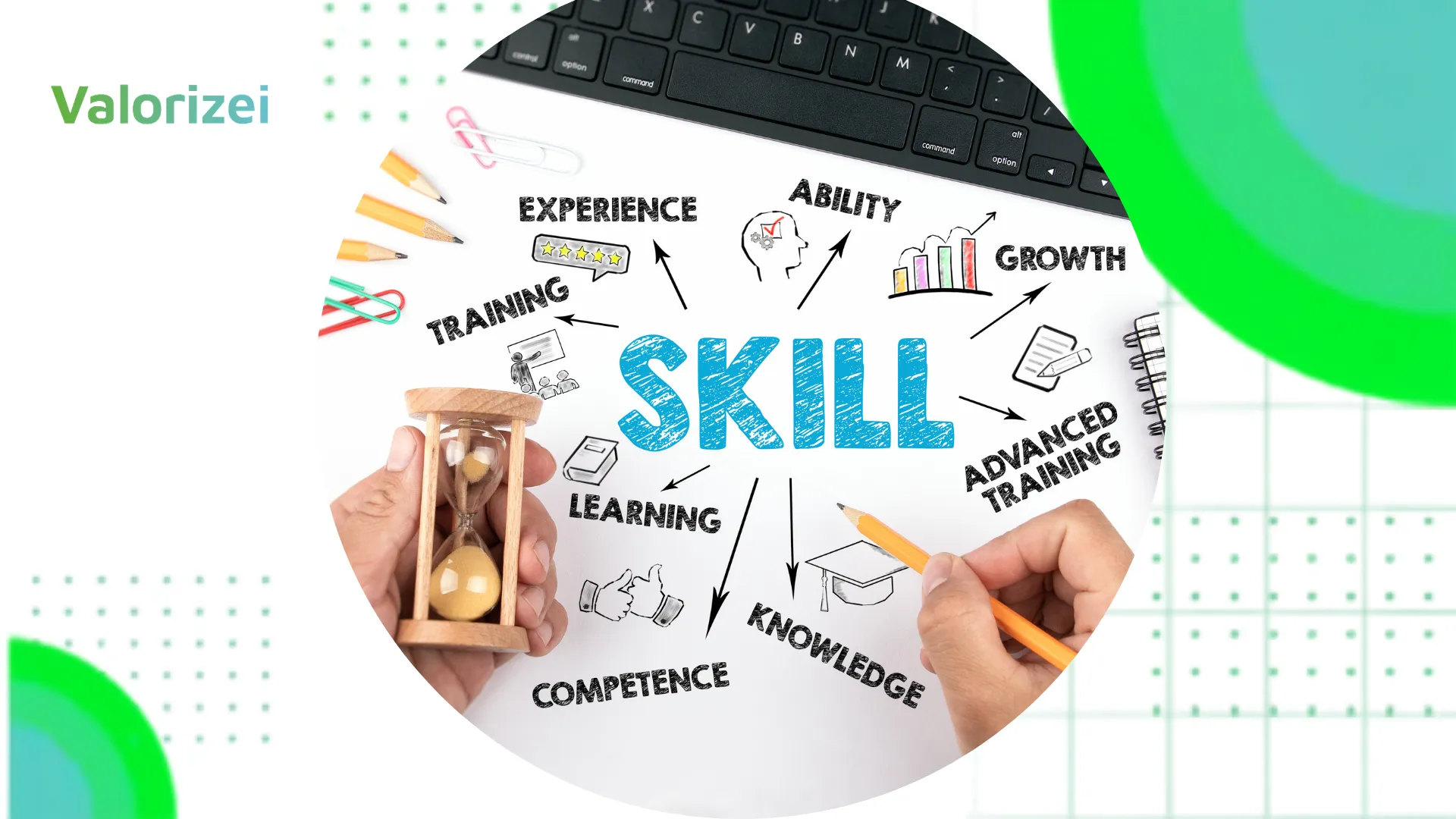
The hybrid professions They represent the strategic convergence between specific technical domains, such as programming or data analysis, and human skills, including communication, empathy, and management.
This dynamic is often misinterpreted as a mere accumulation of functions. In practice, it involves synthesizing expertise to resolve bottlenecks that arise precisely from the fractures between different departments.
The need for this versatility exploded when technology ceased to be an isolated sector and became the very infrastructure of businesses, making operational isolation an extremely expensive luxury.
Reports from World Economic Forum As has been signaling for some time, the ability to learn, unlearn, and connect distant points has become the main currency of the global market.
What are the most valued hybrid professions in today's market?
The market pays a high price for those who can seamlessly navigate between engineering and commercial strategy, such as product managers focused on artificial intelligence.
Another profile in high demand is the data-driven experience designer — someone capable of calibrating cold metrics with the sensitivity needed to understand real human behavior.
In growth marketing, the scenario is identical: the winner is the one who combines the coldness of statistical models with a sharp intuition about consumer psychology.
Even in medicine, the movement is visible: doctors who master data science are leading the transition to predictive diagnoses and personalized treatments in large health centers.
++ Remote international career: where to find job openings
How does the merging of skills impact professional compensation?
The scarcity of professionals with this dual language creates a supply bottleneck. Consequently, those who master these intersections end up dictating salary conditions in negotiations.
There is a clear gain in efficiency: instead of hiring three consultants to mediate a project, companies prefer to pay a single, solution-oriented professional very well.
The table below reflects the valuation range assigned to these positions in the current corporate ecosystem for professionals already working at a senior level.
| Hybrid Cargo | Core Technical Skill | Behavioral/Business Skills | Average Monthly Salary (BR) |
| AI Product Manager | Prompt Engineering and ML | Business Management and UX | R$ 18,000 – R$ 28,000 |
| Commercial Data Scientist | Statistics and Python | Storytelling and Negotiation | R$ 14,000 – R$ 22,000 |
| User Experience Designer (UX/Data) | Information Architecture | Cognitive Psychology and Metrics | R$ 10,000 – R$ 17,000 |
| DevSecOps Engineer | Cybersecurity and Cloud | Communication and Risk Management | R$ 15,000 – R$ 25,000 |
This salary difference does not reward the accumulation of degrees, but the practical ability to unlock decisions blocked by bureaucracy between sectors.
++ Job crafting: a strategy to reshape your career.
What combined skills are most in demand by companies?
The market seeks the uneasy balance between rigorous mathematical reasoning and the emotional intelligence needed to negotiate deadlines, align expectations, and manage crises.
Mastering statistics isn't enough if you fail to translate findings into a persuasive narrative for boards of directors—the so-called art of... data storytelling.
Another critical junction is cybersecurity coupled with legal compliance. Protecting data without hindering innovation has become a daily balancing act for digital companies.
This cognitive flexibility acts as a pivot: it allows the professional to delve into the technical details without losing sight of the financial impact of the operation.
Why does the pursuit of autonomy accelerate the transition to multidisciplinary careers?
This pursuit of autonomy gains momentum as the market stops rewarding the mere repetition of tasks and begins to remunerate critical thinking, the ability to improvise technically, and coordination between different teams.
Professionals who take charge of their own development quickly realize that autonomy doesn't come from a specific job title, but from the ability to solve problems without constantly needing authorization or external mediation.
When you master both the code and the sales strategy, you cease to be just a cog in the machine and become the one who designs your own machine, drastically reducing your dependence on bureaucratic processes.
This operational freedom transforms the work routine: the pressure to mechanically meet hours gives way to deliverables based on real impact, geographical autonomy, and the power to decide the direction of projects.
++ How to use temporary benefits without creating financial dependency.
How to prepare for a hybrid career?

Adopting a mindset of continuous learning is no longer just self-help jargon; it's becoming a survival strategy against the accelerated obsolescence of professional routines.
The safest approach is to audit your own repertoire, identify which complementary skill would have the greatest cross-impact, and seek practical projects outside your comfort zone.
Taking the lead on cross-functional initiatives within your own company is often the ideal testing ground for communication between departments and gaining traction in your career.
Detailed data of International Labor Organization They show that professional flexibility is the dividing line between those who shape the future of work and those who are swallowed up by it.
FAQ – Frequently Asked Questions
What essentially defines a hybrid profession in the current scenario?
It is the functional intersection between deep technical expertise and strategic business vision or human skills, focused on solving problems without relying on intermediaries.
How can I tell if my field of work is becoming hybrid?
Be wary when job postings require fluency in analytical tools for creative roles, or leadership and communication skills for purely technical functions.
What is the difference between a generalist professional and a hybrid professional?
A generalist knows a little about everything without mastering anything. A hybrid professional builds real depth in two or three distinct disciplines and knows how to connect them in practice.
Conclusion
The hybrid professions They cease to be a distant trend and become the rule of the corporate game, requiring the courage to abandon conceptual comfort zones.
Those who dedicate themselves to crossing disciplinary boundaries not only guarantee relevance in the market, but also gain the autonomy to chart their own course in an unpredictable ecosystem.