
O gold in the wallet It has once again become a topic of conversation on trading desks in 2026. After the metal reached successive all-time highs, the feeling in the market is that ignoring this reserve is no longer a prudent option.
Announcements
Given the prolonged geopolitical turmoil and fiscal uncertainty surrounding sovereign currencies, the asset has regained its place of honor. This guide examines how to transform this movement into practical protection for your wealth.
Summary
- Why has gold in the portfolio returned to the forefront of attention in 2026?
- What are the macroeconomic forces driving the price of the metal?
- How to include gold in a portfolio with liquidity and security in Brazil?
- Comparative table of gold allocation instruments.
- What is the ideal percentage of gold in your portfolio for your risk profile?
- Final Considerations
- Frequently Asked Questions (FAQ)
Why has gold in the portfolio returned to the forefront of attention in 2026?
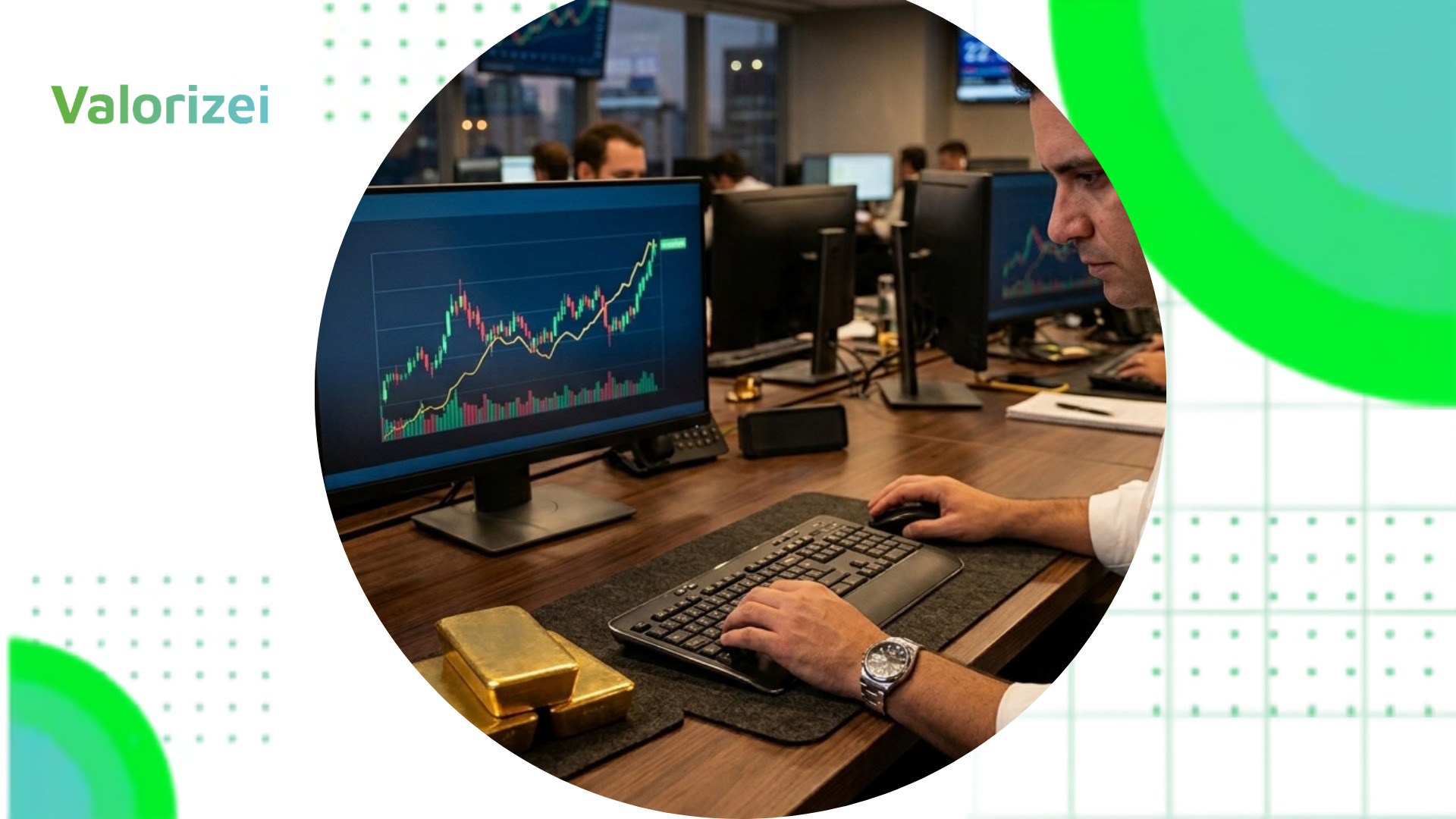
The search for safe-haven assets has even led the most pragmatic managers to reconsider the role of commodities throughout this year.
To maintain gold in the wallet It has moved beyond the outdated idea of habit to establish itself as a sharp risk management tool.
The persistence of global inflationary pressures and the fragility of fiat currencies have simply accelerated this search.
There is a silent element that is often misinterpreted: the frantic buying spree by central banks in emerging countries.
By stockpiling tons of the metal in their international reserves to reduce their dependence on the dollar, these institutions created a firm floor for prices.
For those investing in Brazil, the asset ended up providing double protection, covering both local inflationary risk and exchange rate volatility.
The sophistication of the financial market has eliminated the old operational complexity of storing heavy physical bars inside armored vaults.
In just two minutes, using the brokerage's app, you can buy shares of funds or contracts listed on the B3 (Brazilian Stock Exchange).
This ease of use has transformed a historically rigid instrument into a highly fluid alternative for composing modern portfolios.
What are the macroeconomic forces driving the price of the metal?
The international pricing of this commodity is in direct competition with real interest rates in major economies. When the inflation-adjusted return on US Treasury bonds weakens, market logic changes rapidly.
The ongoing conflicts in Eastern Europe and the continuous tensions in the Middle East act as daily fuel for this search for shelter.
There is something deeply instinctive in institutional capital: at the slightest sign of a fracture in global stability, large funds rush into tangible assets.
It is the instinct for self-preservation that guarantees the metal's ability to endure for centuries without losing its purchasing power.
The behavior of the dollar against the real completes this picture of protection in the domestic environment.
Since the base price of the commodity is in dollars on the international market, the Brazilian investor gains automatic protection when the local currency depreciates.
This near-perfect decorrelation makes the metal a valuable counterweight amidst the usual noise of Brazilian politics and economics.
++ Foreign investment in the stock market: what changes for the Brazilian investor?
How to include gold in a portfolio with liquidity and security in Brazil?
The most accessible alternative for those operating in the Brazilian retail market is to purchase ETFs traded on the B3 stock exchange.
The GOLD11 fund, for example, replicates the performance of the commodity abroad, converted directly to our currency.
He guarantees gold in the wallet with negligible management fees and the advantage of being able to be sold at any time through the online brokerage platform.
Another very popular option is through multi-market funds dedicated to precious metals, offered by almost all investment platforms.
The crucial point here is deciding between versions with or without currency hedging, depending on your appetite for dollar risk.
They make life easier for those looking to automate monthly investments without having to monitor the variable income market daily.
For those already familiar with the dynamics of the futures market, B3 offers trading via fractional contracts, such as the OZ1D lot. This route requires a more prepared stomach and strict control over margin requirements to handle daily settlements.
On the other hand, the purchase of physical bullet casings from distributors has lost ground, stifled by the operational costs of armored transport and private custody.
The evolution of institutional demand for this market is monitored in detail by World Gold Council, institution responsible for consolidated statistics on the commodity globally.
Why do experienced investors hold onto gold in their portfolios even during calmer times?
Maintaining a strategic allocation in this commodity allows investors to take advantage of periods of strong optimism in global markets to rebalance positions without haste.
There is a structural advantage in the decorrelation of metals that often goes unnoticed by most novice investors in the capital markets.
While stocks, corporate bonds, and real estate funds tend to respond similarly to credit and liquidity shocks, commodities maintain their independent price dynamics.
The accumulation of reserves of the metal by international central banks reinforces the argument that its institutional relevance is permanent and structural.
When institutions that issue sovereign currencies decide to stockpile tons of a tangible asset, they are sending a clear signal about the need for diversification and asset risk management.
For those seeking to build a truly resilient portfolio, asset allocation should not be viewed as a bet on global economic doom.
The ease of operation of modern instruments, such as exchange-traded index funds, has eliminated the old barriers to entry for the small investor.
No modern fiat currency has managed to maintain its exchange value intact over the last century, while precious metal has continued to purchase the same basket of essential goods.
Integrating this tactical reserve into your long-term financial planning is, ultimately, an exercise in discipline and maturity in allocation.
The ultimate goal is never to hit the peak of the price, but to ensure that your wealth-building trajectory remains steady in the face of inevitable market storms.
++ IPCA-indexed bonds: when do they still make sense in 2026?
Comparative table of gold allocation instruments.
| Investment Instrument | Type of Protection | Redemption Liquidity | Custody Cost/Fee | Recommended Investor Profile |
| ETF GOLD11 (B3) | Metal + Dollar | D+2 on Home Broker | ~0.30% per year | General / Seeks simplicity and efficiency |
| Unhedgeable Funds | Metal + Dollar | D+1 to D+5 working days | 0.50% to 1.50% per year | Beginner / Automated applications via app |
| Hedge Funds | Physical Metal (Real) | D+1 to D+5 working days | 0.50% to 1.00% per year | Conservative / Seeks to neutralize dollar fluctuations |
| B3 Contract (OZ1D) | Physical Metal/Dollar | D+1 on B3 | Fees + Custody | Experienced trader / Structured operations |
| Physical Bars | Total Physical Reserve | Low (Physical rescue) | High (Safe and special shipping) | Preservation of generational heritage |
What are the most common mistakes when trying to position an asset in a portfolio?

Excitement surrounding bull markets often leads investors to make serious tactical mistakes when allocating resources to the precious metal.
The most common mistake is viewing commodities as a quick source of wealth instead of a protection tool.
Confusing the defensive function of an asset with a recurring income generator is another very common pitfall in financial decisions.
Since commodities do not distribute dividends or monthly interest, concentrating excessive wealth in them sacrifices the multiplier effect of compound interest from fixed income.
Another common misconception in the Brazilian environment is ignoring the direct impact of exchange rate fluctuations when selecting an investment vehicle.
The choice between funds with or without currency hedging needs to be aligned with the specific decorrelation objectives of your personal strategy.
The habit of buying the metal at peak prices, motivated by sensationalist news, generates unnecessary losses for the unwary investor.
Responsible allocation requires investments spread over time or strategic purchases during international market corrections.
Entering an asset when volatility has already peaked significantly reduces the portfolio's long-term cushioning potential.
Neglecting periodic portfolio rebalancing compromises the overall efficiency of your asset allocation in the market.
When the value of a commodity skyrockets during periods of international crisis, its representation in assets grows beyond the planned limit.
Selling surplus assets at higher prices to repurchase discounted, good-quality assets is the key to realizing profits with discipline and consistency.
Finally, acquiring physical gold bars without considering the heavy hidden costs of private custody and secure transport erodes the investor's net profitability.
Digital platforms and exchange-traded funds deliver all the necessary security without the operational expense of traditional vaults.
The immediate liquidity of ETFs allows you to readjust your position instantly whenever economic conditions require it on a daily basis.
++ Etoro Investment, find out everything!
What is the ideal percentage of gold in your portfolio for your risk profile?
The purpose of this asset within a mature strategy is not to generate quick wealth, but to prevent market shocks from destroying what you have already achieved.
Since it neither distributes profits nor pays interest, carrying gold in the wallet Excessive investment can hinder the overall profitability of your assets in the long term. Consider this portion as an insurance policy: necessary, but one that no one wants to fully activate.
Financial literature and the best allocators' practices suggest an exposure ranging between 3% and 10% of net worth.
More cautious profiles, or investors highly exposed to stock market risk, find an excellent buffer in the 10% margin. Aggressive profiles, on the other hand, tend to maintain something around 3% to 5%, just to capture the decorrelation gains during crises.
The secret to this strategy lies in the habit of periodically rebalancing your portfolio. When the commodity price soars and exceeds the share stipulated in your plan, it's time to sell the excess and pocket the profits.
This money returned to the treasury should be channeled into buying discounted fixed-income assets or shares of good companies.
Detailed analyses on the inclusion of commodities in wealth management can be found on the portal. InfoMoney, a benchmark in financial market coverage and tactical allocation.
Final Considerations
The return of gold in the wallet Taking center stage in 2026 exposes a truth that the market tends to forget during years of euphoria: asset protection needs to be built before the storm arrives.
Continued support from central banks and the ease provided by publicly traded vehicles have democratized access to a resource that was previously restricted to the very wealthy.
The success of this allocation depends on operational composure and absolute respect for the limits of your risk profile. Treating a defensive commodity as if it were a speculative bet usually frustrates the unwary investor.
By maintaining a conscious and balanced position between 3% and 10%, you ensure that your portfolio remains viable, regardless of the global economic scenario.
Frequently Asked Questions (FAQ)
Does gold generate dividends or monthly income?
No, the metal is a physical reserve that does not generate cash flow, coupons, or dividends. All returns obtained from this investment depend exclusively on fluctuations in the asset's price on the global market.
What is the practical difference between investing in gold funds with or without currency hedging?
The unhedged option varies according to the international price of the commodity plus fluctuations in the dollar against the real. The hedged option neutralizes the US dollar, causing the fund to track only the price of the metal.
How does income tax work on gold investments in Brazil?
In the trading of ETFs like GOLD11, a fixed income tax rate of 15% is applied to capital gains from the sale. In traditional investment funds, the tax follows the regressive fixed income or multi-market tax table.
Is it worth buying physical gold or is it better to use ETFs on the B3 (Brazilian stock exchange)?
ETFs offer much greater ease of use, low operating costs, and immediate liquidity within the B3 (Brazilian stock exchange) environment. Physical gold requires payment for secure shipping, insurance, and fees for maintenance in authorized vaults, which reduces its practicality.