

How to study on public transport without losing performance It requires a profound reorganization in the way the brain processes information in dynamic and noisy environments.
Announcements
Learning on the go is not an unavoidable sacrifice for those who face long commutes, but a strategic opportunity to optimize daily routines with the right tools.
Transforming time spent commuting daily into net learning hours requires method, adaptive focus, and the right choice of content formats.
Summary
- Why does the public transport environment affect your performance?
- What are the main cognitive obstacles to commuting?
- How do you organize your study materials for the bus or subway?
- Which content formats work best in each situation?
- How can you use technology to shield your attention?
- Comparative table of study formats in transit.
- What health precautions can help prevent mental fatigue during the commute?
- Consolidating study habits on the go.
- Frequently Asked Questions (FAQ)
Why does the public transport environment affect your performance?
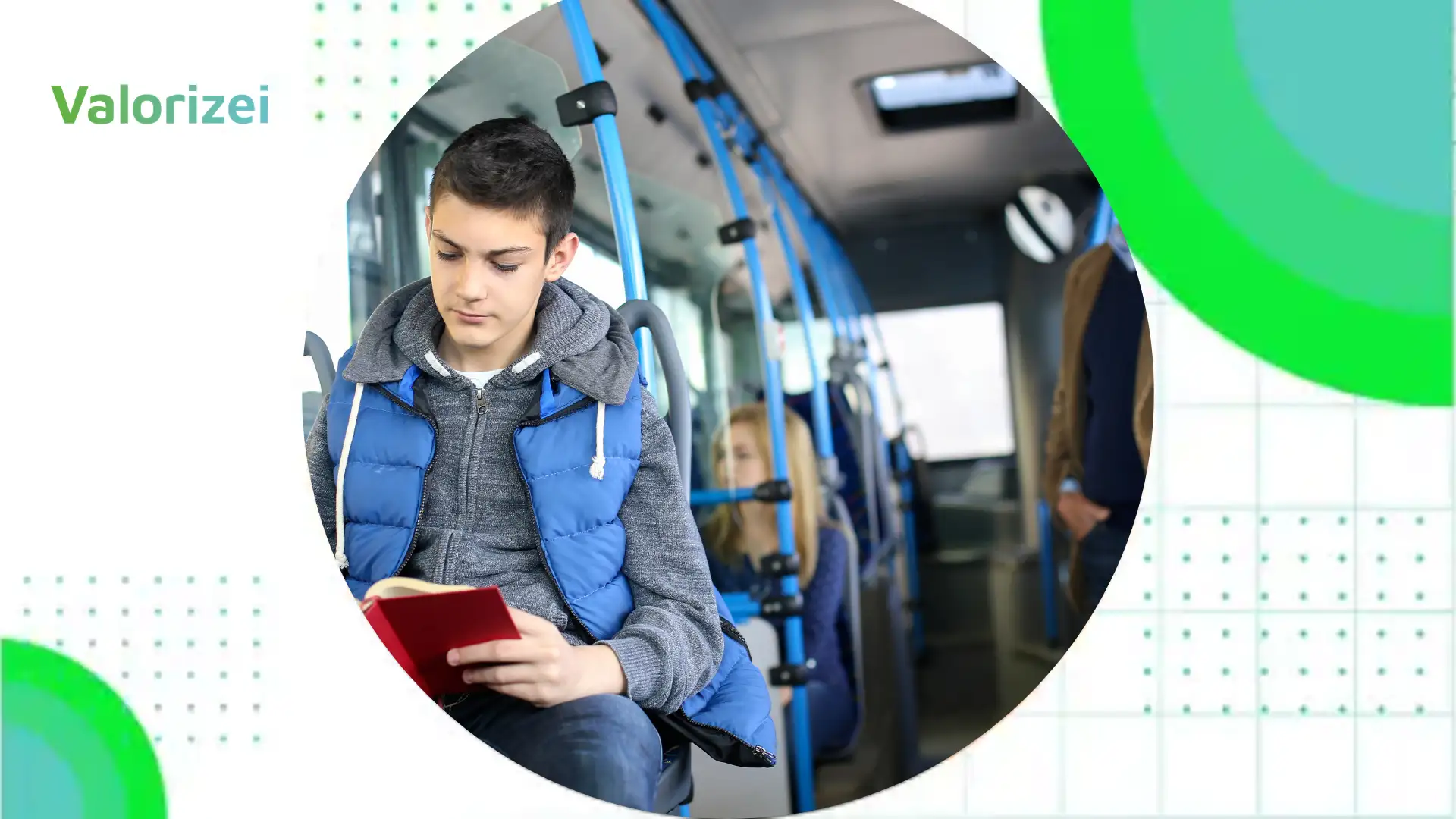
The constant swaying of the train cars and the overload of visual stimuli demand a herculean effort from the brain to maintain focus on the page.
This invisible friction devours our mental energy long before the first hour of travel is over, draining the critical retention capacity of any reader.
Learn to Studying on public transport without losing academic performance It involves recognizing these neuroscientific limitations and ceasing to demand library-like silence from the brain during rush hour traffic.
What are the main cognitive obstacles to commuting?
Unpredictable urban noise acts as a silent saboteur, fragmenting the continuous flow of thought and making reading dense texts a thankless task.
There is also the constant physical friction from daily bumps and jolts, which tenses the muscles without us realizing it and generates a bodily fatigue that is difficult to explain at the end of the day.
To make matters worse, the abrupt changes in lighting between tunnels and open avenues strain the eyes, turning the act of reading into a marathon of eye strain.
How do you organize your study materials for the bus or subway?
The decision about what to read needs to be made before leaving home, avoiding wasted attention spent aimlessly browsing through digital files in the middle of a trip.
Dividing the content into self-contained ten-minute micro-blocks works almost like a positive mental trick, delivering small learning victories at each stop along the way.
Mastering how Studying on public transport without losing academic performance It requires downloading all the material beforehand, as relying on the fluctuating signal of mobile internet destroys any attempt at immersion.
Which content formats work best in each situation?
Traveling while standing in a crowded aisle requires shifting your strategy to audio materials, making audiobooks and analytical podcasts your greatest allies in the chaos.
Once a seat is secured, using spaced repetition apps transforms the journey into fertile ground for actively memorizing key concepts and vocabulary.
Insisting on handling bulky physical books and heavy notebooks in cramped spaces is usually the perfect recipe for giving up on studying after five minutes of trying.
How can you use technology to shield your attention?
Headphones with active noise cancellation act like a true acoustic bubble, isolating the deafening noise of engines and other people's conversations without requiring extremely high volumes.
Setting screens to night mode reduces the impact of artificial light directly on the pupils, ensuring extra hours of comfort during longer reading sessions.
Consult the guidelines of Ministry of Education It helps to select structured content with valid methodologies for this type of rapid and targeted absorption.
Comparative table of study formats in transit.
Choosing the right tool depends directly on the physical dynamics of the route and the level of turbulence encountered on the daily commute to the final destination.
+ Reverse study: how to learn by solving problems first
| Condition on the Route | Recommended Format | Suggested Tool | Expected Retention Level |
| Standing and packed | Audio (Podcasts/Audiobooks) | Bluetooth headphones | Average |
| Sitting with turbulence | Digital Flashcards | Repeating Applications | High |
| Sitting and stable | Reading Summaries | Digital Readers (e-readers) | Very High |
| Slow and stopped traffic | Problem Solving | Online Simulation Apps | High |
What health precautions can help prevent mental fatigue during the commute?
Dizziness and nausea occur when the brain receives conflicting signals from the body's inner ear and from eyes fixed on a screen that appears perfectly static.
Raising the device slightly to eye level reduces this sensory imbalance, while quick pauses to look at the horizon help to recalibrate internal balance.
Know Studying on public transport without losing academic performance It also means accepting that there are days when tiredness wins, and resting your mind is the smartest choice.
+ How to eliminate digital distractions without uninstalling social media.
What is the impact of visual ergonomics on content absorption during travel?
The constant tilting of the neck to look at a cell phone on the lap generates a silent cervical overload that compromises blood flow and accelerates cognitive fatigue.
Positioning the screen or e-reader at natural eye level reduces muscle tension in the shoulders, allowing attention to remain fully focused on absorbing the reading material.
How do you map the peak and trough times on your daily commute?
Identifying variations in occupancy along your usual route allows you to plan the alternation of cognitive tasks with surgical precision throughout the journey.
Reserving the initial, quieter parts of the trip for in-depth reading ensures a better learning experience, while busy boarding times call for passive audio content.
Knowing how to adapt the pace of learning to the dynamics of traffic means mastering the topography of your own route to alternate between effort and rest at the right time.
+ Hybrid studies in 2026: how to balance online classes, in-person classes, and self-learning.
Consolidating study habits on the go.

Creating a solid study routine doesn't depend on blind motivation, but on the daily alignment between realistic expectations and small goals achieved with technical consistency.
With daily practice, the brain learns to enter a state of flow almost instantly upon sitting in the seat, shielding the mind from the external environment.
To monitor urban mobility studies in National Association of Urban Transport Companies It helps to identify alternative schedules and less strenuous commutes in daily life.
Frequently Asked Questions (FAQ)
Is it worth trying to read physical books on the bus?
The weight and fragility of paper make physical books impractical for busy commutes, while e-readers offer an incomparably lighter and more ergonomic option.
Is audio really effective for memorizing content?
Audio formats work perfectly for memorization and review, as long as they are later complemented by short notes or mind maps during quiet moments.
How long should I study continuously during my commute?
Increasing focus in short, twenty-minute bursts preserves cognitive energy without causing the visual fatigue so common in prolonged urban travel.