

Learn how to calculate purchases in dollars on your credit card
Announcements
To avoid surprises and even exorbitant amounts on your card, you need to know how to calculate purchases in dollars on your credit card.
In fact, if you have already made international purchases using this tool, it is very likely that you were shocked by the bill due to the dollar exchange rate for your purchase.
To learn more about this topic, continue reading. We will explain how it all works.

How to calculate purchases in dollars on a credit card?
Before anything else, it is important for you to understand that when converting dollars using a credit card, each institution charges a certain amount.
Additionally, banks often include a surcharge (known as a spread) and use an official quote as a reference.
The official exchange rate used as a reference is usually the Ptax Dollar, the exchange rate calculated by the Central Bank.
The surcharge is typically around 2% to 5%. This means that the dollar charged in the conversion is almost always the Ptax plus this amount.
What is Ptax dollar?
The Ptax dollar is an exchange rate used to calculate the amount you spend on international purchases.
In other words, it is the price of a foreign currency in relation to the Brazilian currency, the real.
Ptax is the main exchange rate reference for the public, researchers and economic analysts, according to the Central Bank.
It is used in several foreign exchange market products, such as:
• Futures contracts
• Exchange options listed on the Stock Exchange
• Over-the-counter derivative contracts traded in the local and foreign markets
• Financial operations of companies in the foreign exchange segment with physical delivery
• Real-denominated contracts on overseas commodity exchanges, such as the Chicago Mercantile Exchange (CME) in the US
Is IOF charged on this transaction?
In addition to the Ptax dollar with the surcharge, it is necessary to consider the IOF.
IOF stands for Tax on Financial Transactions. It is a federal tax paid by individuals and legal entities on any financial transaction, such as credit, insurance, foreign exchange, securities and bond transactions.
The IOF has a rate of 6.38% for purchases in dollars made using a card.
Therefore, it is important that you make this calculation, so that you can know if the purchase is advantageous for your case.
From 2023 onwards, this rate will also be gradually reduced by 1 percentage point per year:
• 2023: 5,38%
• 2024: 4.38%
• 2025: 3.38%
• 2026: 2.38%
• 2027: 1.38%
• 2028: 0%
Source: Finance One

Dollar on credit card: what is the amount charged?
Most card administrators provide quotes online or through their apps.
To check this information, you can go to the website of the desired institution! After all, each bank has the right to use its own rules.
Is it advantageous to make purchases in dollars with a credit card?
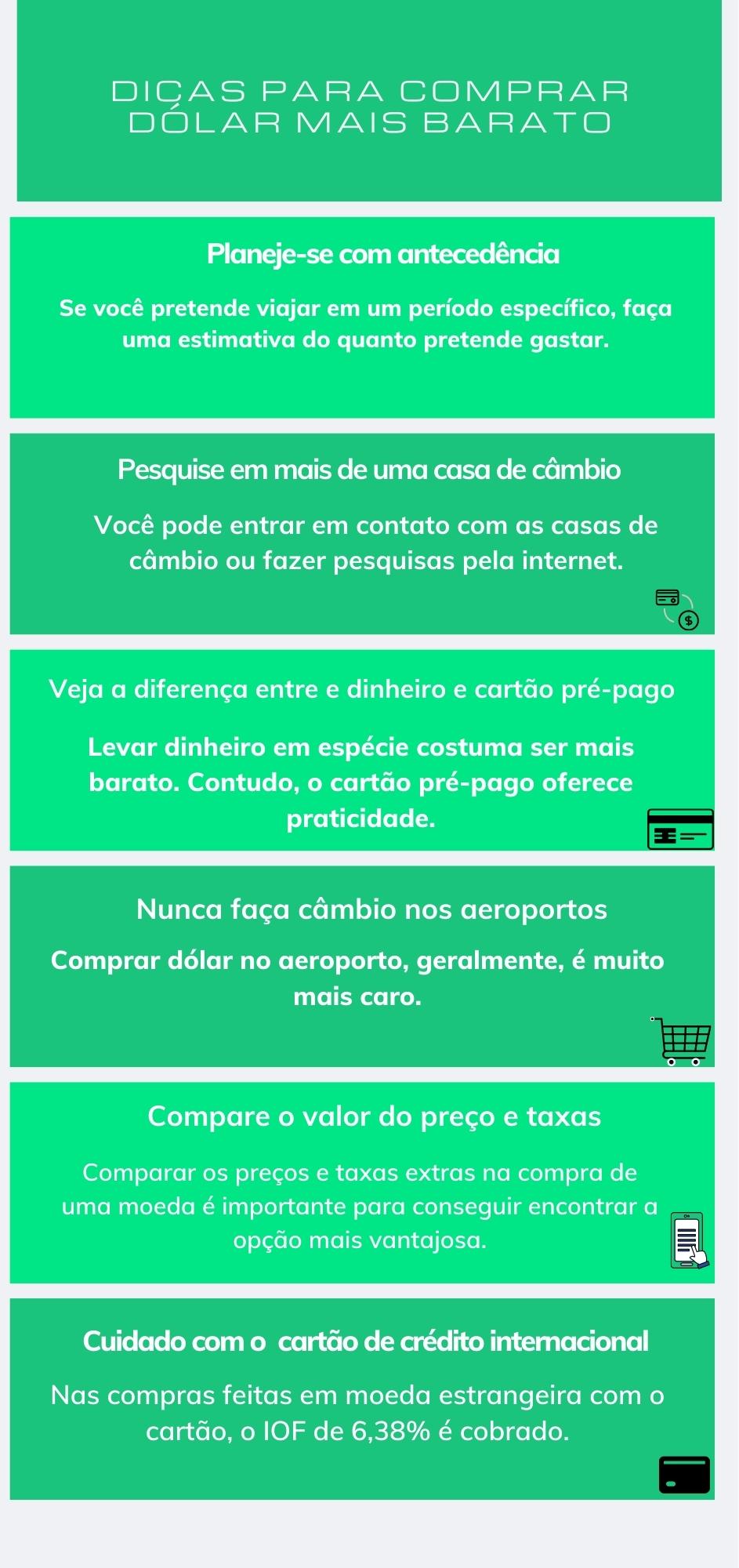
Cash is the cheapest way to buy dollars.
After all, the IOF is 6.38% on the card. The purchase of foreign currency in cash is 1.10%.
It is also important to remember that some financial institutions charge a surcharge on the dollar exchange rate that can reach 5% of the dollar value on the day.
Dollar rate on the invoice
Which dollar should be taken into consideration to add up the final amount: the one on the day of purchase or the one on the closing date of the invoice?
This is one of the main questions for those who want to calculate purchases in dollars on a credit card.
According to a Central Bank rule, which has been in force since 2020, the dollar to be considered by the credit card is that of the day of purchase.
Travel money: dollar x prepaid x credit card
This is a very common question for those who want to travel abroad.
After all, what is the best option on the market? That’s what we’re going to show you now.
Check out the advantages of each of these options below:
Cash dollars
As we said, taking dollars in cash ends up being more advantageous financially, as it is the cheapest way to buy dollars.
Furthermore, carrying cash can be useful when paying for a taxi that does not accept cards, tipping, among other things.
Another advantage is that this form of payment is accepted practically everywhere.
The disadvantage of traveling with only cash is the insecurity in case you are robbed.
Tip: Before buy dollar, Contact several currency exchange offices. This way, you can find out which one is charging the least. In some cases, you can even negotiate the rates.
Prepaid card
The international prepaid card is one of the most practical options for those who want to travel abroad.
This card can be loaded and unloaded whenever necessary, even when you are outside the country.
In practice, it is similar to a debit card, meaning you can make purchases in stores and withdraw money from ATMs.
There are several types of prepaid cards.
To find out which one is the most advantageous for you, it is a good idea to contact the company in question to find out what fees are charged, monthly fees, whether it is necessary to have a bank account with the institution, among others.
In case of loss or theft, you will be reimbursed with the amount available on the card.
Regarding the disadvantages, we can mention the fees, such as the issuance and withdrawal fee and the IOF (Tax on Financial Operations) of 6.38%.
credit card
A credit card is also a more practical and safer option.
Furthermore, it is a good option for those who want to accumulate miles.
The disadvantage, in this case, is the Tax (IOF) of 6.38% on any purchase made abroad with the credit card.
Conclusion
Now you know how to calculate purchases in dollars on your credit card.
However, even though this option is practical and safe, it is not the cheapest.
But if you have a credit card that accumulates miles, offers travel benefits or doesn't have a premium on the dollar exchange rate, it might be interesting to use this tool!