

Access to quality education in Brazil has always been an obstacle course, but ensuring school retention through... Assistance for high school students It has assumed a central role in the 2026 social strategy.
Announcements
This financial support attempts to stop an old problem: school dropout, which pushes young people into early and unskilled work.
With the recent updates to the rules, the system has become more efficient, although it requires increased attention from beneficiaries.
In the following lines, we detail how the program works in practice, the cut-off criteria, and what has really changed for those currently working in public schools. Understanding these mechanisms is the first step in ensuring that this right doesn't slip through our fingers.
Table of Contents
- Who will be selected in 2026?
- The discipline of attendance and the risk of suspension.
- The logistics of payments and the financial "cushion".
- The digital path for registration and consultation.
- The social function of aid beyond the figures.
- Direct Answers (FAQ).
Who is eligible for the High School Student Aid in 2026?
The eligibility filter for 2026 is clear: the benefit is aimed at those enrolled in the public school system — whether state, municipal, or federal.
The main driver of this selection process continues to be the Unified Registry (CadÚnico), which acts as a barometer of social vulnerability in the country.
There's an important nuance here: simply being in school isn't enough; the family income needs to fall within the limits established by the Ministry of Social Development.
One point that causes confusion, but is worth highlighting, is that EJA (Youth and Adult Education) students also participate, provided they meet the age and vulnerability requirements.
To avoid unpleasant surprises such as blocked funds, registration data must have been reviewed within the last two years. This digital link between the school census and social assistance systems is what ensures that the money reaches its destination without misappropriation.
Families already enrolled in the Bolsa Família program have almost automatic priority in the process. For these young people, the aid is not just extra money, but a survival tool that allows them to stay focused on their studies instead of seeking informal jobs.
What are the attendance rules for maintaining the benefit?
The golden rule is presence. To maintain the Assistance for high school studentsThe student needs to maintain a minimum attendance of 80% in classes.
In an increasingly digital system, the old paper-based call has given way to real-time records.
Unexcused absences are not just a pedagogical problem; they directly impact students' finances. The system is programmed to suspend payments when it detects that the absence limit has been exceeded, acting as an immediate indicator of student engagement.
It's important to be cautious about unforeseen circumstances. Health issues or force majeure situations require prompt documentation, as bureaucracy, while efficient, doesn't forgive a lack of proof. The school is not just a place of study, but also the validating agent for your benefits.
The government uses these attendance rates to identify where education is failing. When a region shows sharp drops in attendance, the aid serves as the first warning sign for deeper, more localized social interventions.
How does payment and completion bonus work?
The program's financial architecture is clever: it blends immediate relief with a promise of the future.
Payment is split between monthly maintenance deposits and a savings account that can only be withdrawn after the long-awaited diploma is obtained.
The money is deposited into digital accounts automatically opened in the student's name. This choice is not accidental; it introduces young people to financial autonomy, allowing them to manage their resources through apps, without depending on intermediaries.
Upon crossing the finish line of the third year, the accumulated amount is released. It's a powerful psychological incentive to prevent students from dropping out halfway through, offering financial breathing room for those who wish to enter college.
+ Unified Registry in 2026: how to update data and maintain benefits
Table of Values and Criteria of the Program (Data 2026)
| Transfer Category | Estimated Value | Frequency | Main Criterion |
| Enrollment Incentive | R$ 200.00 | Annual | Confirmation of enrollment at the beginning of the cycle. |
| Student Support Grant | R$ 200.00 | Monthly (10 months) | Classroom attendance above 80% |
| Completion Bonus | R$ 1,000.00 | Annual (cumulative) | Full approval in all subjects of the year. |
| Encouraging ENEM (Brazilian National High School Exam) | R$ 200.00 | Single Payment | Full participation in both days of the exam. |
Where can I register for the high school student aid program?
There's an almost invisible practicality here: registering on Assistance for high school students It is usually automatic.
The cross-referencing of data between the Ministry of Education and social services eliminates the old, cumbersome process of visiting various government offices.
Every month, education departments update their enrollment database. If you meet the requirements and your name doesn't appear in the system, the error is usually administrative or related to your registration; in that case, contacting your own school's administration office is the first place to go.
One technical detail that many forget: the student's CPF (Brazilian taxpayer ID) needs to be "clean" with the Federal Revenue Service. A document suspended for trivial reasons, such as electoral irregularities, can stall the entire bank account opening process.
Complete control is at your fingertips through the "Student Journey" app. There, students receive payment notifications and alerts about outstanding issues, transforming what was once a nebulous process into something transparent and monitorable.
What documents are needed for updating registration information?
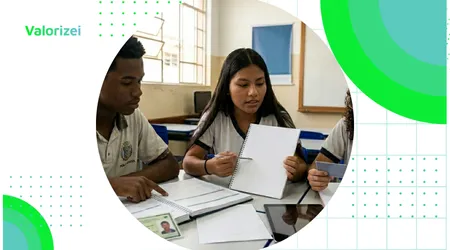
Maintaining the CadÚnico (Single Registry for Social Programs) is the heart of the process. Without updated information — ID, CPF (Brazilian taxpayer ID), and proof of residence reflecting where the family actually lives — the system simply assumes that the beneficiary no longer exists or no longer needs the benefit.
Your enrollment certificate is your shield in case of audits. Although the system is integrated, having the document on hand speeds up the resolution of conflicts when the digital system fails, something that, let's be realistic, still happens occasionally.
Any change in the household dynamics, such as someone starting work or moving, needs to be reported to the CRAS (Social Assistance Reference Center).
The government cross-references banking and employment data; withholding information is the quickest way to have your account permanently canceled.
The visit from social workers should not be viewed with apprehension, but as a necessary validation. The seriousness with which this information is handled is what keeps the program running and prevents scarce resources from being unfairly squandered.
What is the socioeconomic impact of the aid on the lives of young people?
The money injected directly into the student's hands alleviates the suffocating pressure of having to choose between a notebook and a store counter. This financial relief allows young people to enjoy their learning time with more dignity.
It's not just about statistics, but about social mobility. Assistance for high school students It acts as a buffer against inherited poverty, breaking the cycle where the child abandons their studies for the same reason their parents did.
There is also an invisible gain in self-esteem. The student ceases to be a "cost" to the family and becomes an agent of their own education.
This empowerment is reflected in the school climate, creating an environment where completing high school is the norm, not the exception.
Societies that invest in the foundation reap more productive and conscious adults. Education, when supported by a minimum of financial security, ceases to be a privilege of the few and becomes the real engine of national transformation.
+ My Home, My Life in 2026: new rules and income requirements
How does performance on the ENEM exam influence receiving the bonus?
For third-year students, the ENEM exam is not only the gateway to university, but also a trigger for an extra boost of encouragement.
This rule is a clear attempt to reduce the competitive gap between public and private education.
The logistics are simplified: did you attend both Sundays of the exam? The INEP system notifies Caixa and the deposit is processed.
It's a bonus for effort, a recognition that the school cycle was completed in its entirety, up to the final challenge.
This extra money is usually the breathing room needed to pay for travel or small fees for other university entrance exams.
It's an investment in the "next step," ensuring that the journey doesn't end abruptly on the last day of high school.
This integration reinforces the State's commitment not only to educating students, but also to encouraging them to occupy spaces in higher education.
Every penny invested here aims at the real democratization of academic opportunities.
Main reasons that lead to the suspension of benefits.
The beneficiary's Achilles' heel is attendance. Abandoning the classroom or neglecting attendance cancels the benefit. Assistance for high school students No room for complaints. The state pays for attendance and commitment to learning.
Neglecting the Unified Registry (CadÚnico) is the second biggest culprit. Going more than 24 months without updating your information is practically asking for your benefit to be blocked.
The system interprets the beneficiary's silence as a change in circumstances that no longer requires assistance.
Bureaucratic problems with the CPF (Brazilian taxpayer ID) also freeze the account. Sometimes the money is there, but the student can't withdraw it because the document is irregular.
This is the kind of headache that can be avoided with a simple check on the tax office website.
Finally, migrating to private education without the support of specific social grants disconnects the student from the payroll.
The program's focus is to strengthen public schools, and leaving this ecosystem automatically terminates the link to the benefit.
Final Considerations
The design of this program in 2026 shows that the country has finally understood that education is not just about chalk and blackboard, but about food and financial security. The aid is a bridge, but it's the student who needs to cross it.
Staying informed about deadlines and meeting attendance goals is what separates success from the interruption of benefits.
The impact of this investment will be felt in the coming decades, with a more skilled and aware workforce.
For a broader view of how these resources are managed and the importance of financial inclusion for young people, the portal of Central Bank of Brazil It offers valuable data.
The future of public education depends on this mutual commitment between the state that provides and the student who is dedicated.
FAQ – Frequently Asked Questions
1. Can this aid be combined with Bolsa Família?
Yes. They occupy different shelves in social assistance and one does not exclude the other, functioning as supplementary income for the family.
2. Can students from Federal Institutes (IFs) receive it?
Absolutely. Students in technical high schools at federal institutions are fully covered by the program, provided they meet the income criteria.
3. If I fail the year, do I lose everything?
Failing a course due to grades cancels the completion bonus for that specific grade level, but the student can continue receiving monthly payments as long as they are enrolled and present.
4. How do I withdraw my end-of-course savings?
The funds are released digitally after the school confirms your graduation in the official system. The accumulated amount is then available in your social savings account.
5. Do those who study at night also earn the same amount?
Yes, the program does not discriminate based on shift. The cost and attendance rules are exactly the same for all periods.