
Discover the types of Treasury Direct bonds!
Announcements
If you are a more conservative investor (with less tolerance for risk), you have certainly already researched the main types of Treasury Direct bonds.
Tesouro Direto is the National Treasury platform used to sell government bonds in Brazil.
As people become more interested in investing, the number of Brazilians wanting to invest in treasury bonds has increased considerably in recent years.
And if you're one of them, you're in the right place. In today's article, we'll explain everything about this fixed-income investment and the bond options available. Treasury Direct. Continue reading to find out more.

3 options to choose from: what are the types of Treasury Direct bonds?
Basically, there are three options for you to consider in your fixed income investment strategy, based on your short, medium, and long-term goals.
Let's now understand the differences between the titles.
1. Prefixed Treasury
Prefixed bonds allow the investor to know exactly the value of the return at the time of purchase.
In other words, its main characteristic is fixed profitability, which presents an interest rate with a percentage that does not vary.
This way, if you choose a fixed-rate Treasury bond to invest in, you will know the return you will receive on the investment's maturity date.
Depending on your investor profile and financial goals, fixed-income securities can be very worthwhile. In fact, there are several positive aspects worth highlighting, such as:
• Know exactly the profitability at the time of application
• Easy application and redemption
• Low risk
These bonds are typically preferred when interest rates are expected to fall. This makes it easier to secure attractive returns with a fixed rate.
But if the Selic rate is high and has prospects of remaining that way, it may be more interesting to invest in the Tesouro Selic.
2. Selic Treasury
The Selic Treasury has this name because its remuneration is linked to the Selic rate.
This means that it is an investment with post-fixed profitability.
In this case, the gain depends on the behavior of an indicator, which, as we have already mentioned, is the Selic rate.
Selic is the main monetary policy instrument used by the Central Bank (BC) to control inflation.
Every 45 days, the Monetary Policy Committee (Copom) meets to set the value of the country's base interest rate.
When the objective is to stimulate the economy and consumption, COPOM tends to reduce interest rates, making loans and financing cheaper.
On the other hand, when there is inflationary pressure, the government increases the base interest rate as a way to control inflation.
The main advantages of Selic Treasury bonds are:
• Has the lowest risk in case of advance sale
• It is recommended for those who want to create an emergency reserve
• It is more advantageous for short-term goals
3. IPCA Treasury
The profitability of the IPCA Treasury is linked to inflation, measured by the variation in the Broad National Consumer Price Index – IPCA.
In addition to the title being indexed to the IPCA, a fixed fee is also added for each transaction.
In other words, in this case, all bonds track inflation and yield a fixed rate, which may vary between them. Therefore, it is a hybrid fixed-income security.
Among the main advantages of IPCA bonds, we can mention:
• Protect the investor from inflation fluctuations
• Ensures profitability above inflation
• It is more advantageous for medium and long-term goals
What is the best Treasury Direct bond?
This question is very common among beginner investors.
After all, which of the Treasury Direct bonds is the best option for your investment portfolio?
Initially, the best “title” depends on your investor profile and financial goals.
Of course, the economic situation also makes a difference. For example, when interest rates are constantly rising, fixed-income securities are not the best option, as the return may end up being negative if you redeem them early.
It's also important to consider inflation, which can cause you to lose purchasing power in the long run.
Therefore, if the intention is to protect your purchasing capital from inflation, especially in the medium and long term, the Treasury IPCA is an investment that protects your money from inflation.
It is important to remember that the ideal is to hold the security until the maturity date, as the mark-to-market effect may occur.
Direct Treasury Simulator: How to choose the best bond to invest in?
Did you know that you can use the website's own simulator to analyze the available titles?
When you enter the page, you will come across the Treasury Direct bonds, the profitability of each one of them and the minimum investment amount.
With some information, you can already predict how much your investment will yield in a given period.
Click here to access the simulator.
How is Treasury Direct taxation?
Treasury Direct is subject to Income Tax.
But it only applies to the income for the period of the investment, not the total amount invested.
Taxation occurs in the same way as in other fixed income investments.
IR follows the regressive table.
Therefore, your investments in Treasury Direct bonds are subject to the following charges:
• Up to 180 days: 22,5%
• Between 181 and 360 days: 20,0%
• Between 361 and 720 days: 17,5%
• Over 720 days: 15,0%
In addition to income tax, the Treasury is subject to the Financial Transactions Tax (IOF). However, this tax only occurs in the first thirty days of the investment.
Conclusion
Now you know the main Treasury Direct bonds and the characteristics of each one.
In fact, even with income tax, this fixed-income investment offers more advantageous returns than savings accounts.
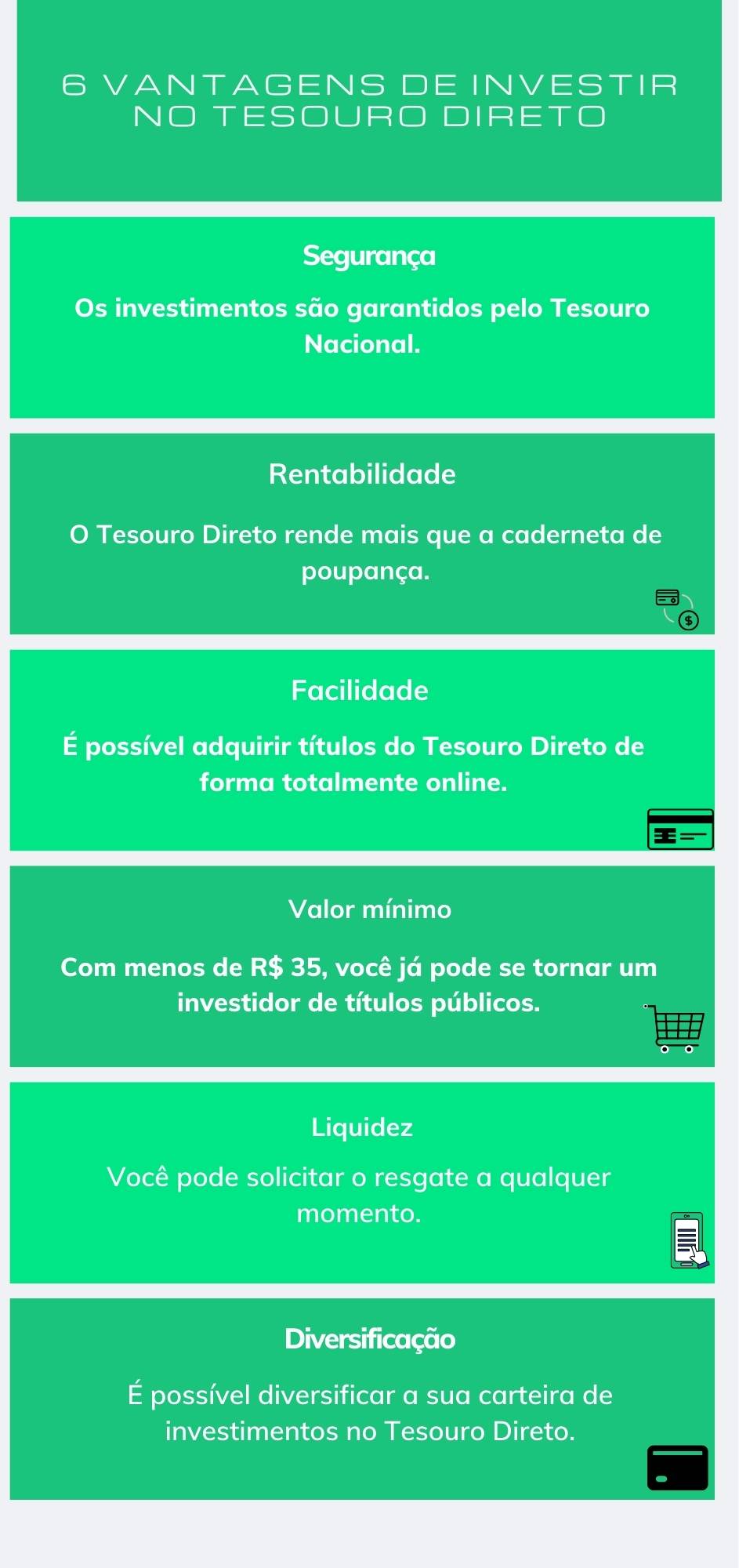
Therefore, Tesouro Direto is a great option for those who prioritize liquidity, security, and good profitability!