
What are the most popular types of fixed income?
When researching the financial market, it's important to know what the most popular types of fixed income are. So read to the end and learn all about this type of investment!
Announcements
For a long time, opening a savings account seemed to be the best way to save money. But because of the low yields, the ideal is to look for other types of investment.
To help you be more confident when investing and make your money earn more, we're going to talk about the most popular types of fixed income.
Read on to find out all about it.
The advantages of the most popular types of fixed income
In practice, fixed-income investments work like a loan.
The investor will choose an investment option that can be offered by the government or by a private company. financial institution.
After choosing a financial product, the investor will pay the financial amount and in return receive a security.
After the established period, you, who "lent" your money, will receive it with interest, which was defined at the time of contracting.
The yield can be fixed or floating.
The main advantages include:
- Security
- Liquidity
- Accessibility
- Stable profitability

The most popular types of fixed income in 2021
Now that you know what fixed income and the main advantages of this type of investment, it's time to get to know the main options. Check them out:
1. treasury direct
Tesouro Direto has attracted the attention of investors because it is a safe option and offers higher returns than traditional savings.
It is a bond issued by the Federal Government.
In other words, you invest your money and, in return, you receive it plus interest on maturity, which is set at the time of purchase.
Another advantage of Tesouro Direto is that it is extremely accessible even to Brazilians who can't or don't want to invest a lot of money.
You can start investing in these assets from as little as R$ 30.00.
2. CDB (Bank Deposit Certificate)
The CDB is one of the most popular investments for those who prefer to invest their capital in fixed income.
The main reasons are profitability and security, since it can offer good financial returns but without the high risks of equity investments.
But what is a CDB and how does it work?
Those who buy CDBs are lending money to banks to raise funds and thus finance their lending activities.
Banks raise funds with CDBs by offering a return - interest.
This means that at the end of the maturity date, you will receive your money with interest.
When investing in CDBs, it is likely that you will come across a minimum amount required by financial institutions. This could be as little as R$ 100.00 or as much as R$ 5,000.00.
3. LCI and LCA
Did you know that the LCI (Real Estate Credit Bill) and the LCA (Agribusiness Credit Bill) are investments free of fees and taxes?
And that's one of the reasons why these investments are becoming one of the most popular types of fixed income.
In practice, they work very similarly, as both are exempt from income tax and are guaranteed by the FGC (Fundo Garantidor de Créditos).
What changes between them is their purpose, since one is aimed at the agribusiness sector and the other at the real estate sector.
But for the investor himself, it doesn't make much difference to buy LCI or LCA paper, unless you're interested in investing your money in exactly one of these two sectors.
When the market is hot for real estate investments, there are more LCIs available.
The same goes for LCA. In times of agricultural expansion (which is what is happening in 2021), there are more LCAs available.
To choose an LCI or LCA that is in line with your financial objectives, you need to take into account the initial contribution, the rate of return and the maturity date.
Investing in these securities is an excellent option for those who want to escape the low yields of savings and are looking for safe investments.

4. Bills of Exchange
The Bill of Exchange, or simply LC, is a credit instrument offered by financial institutions that represents a payment order.
This investment works in much the same way as a CDB.
The advantages of the LC are that it is considered safe and has a good return, making it an alternative for diversifying your portfolio with other of the most popular fixed-income investments.
The yield can be linked to the CDI or combined with a fixed rate plus the IPCA, such as 105 % of the CDI or 3.5% + IPCA.
5. CRI/CRA
CRI stands for Real Estate Receivables Certificate and CRA for Agricultural Receivables Certificate.
We are talking about two investments with high profitability, low financial risk and issued by securitization institutions.
To help you understand how these investments work, we'll give you an example.
Imagine that someone has just financed a property on the drawing board. They're going to pay for their new apartment in installments over, say, 20 years (with interest, of course).
But in order to build the building in which the person will live, the construction company needs money as quickly as possible.
And for the construction company to raise funds, it will pass on the debt to the securitization company, which will issue the CRI.
The difference between CRIs and CRAs is the origin of the securitized receivables.
In CRI, the credit backing is related to the real estate sector. In the case of the CRA, they are related to agribusiness, such as inputs, agribusiness machinery, marketing, etc.
CRIs and CRAs work in a similar way to other fixed-income investments: the investor buys the paper, keeps the funds invested and receives interest in return.
Conclusion
Now that you know what the most popular types of fixed income are, it will be easier to make good investments.
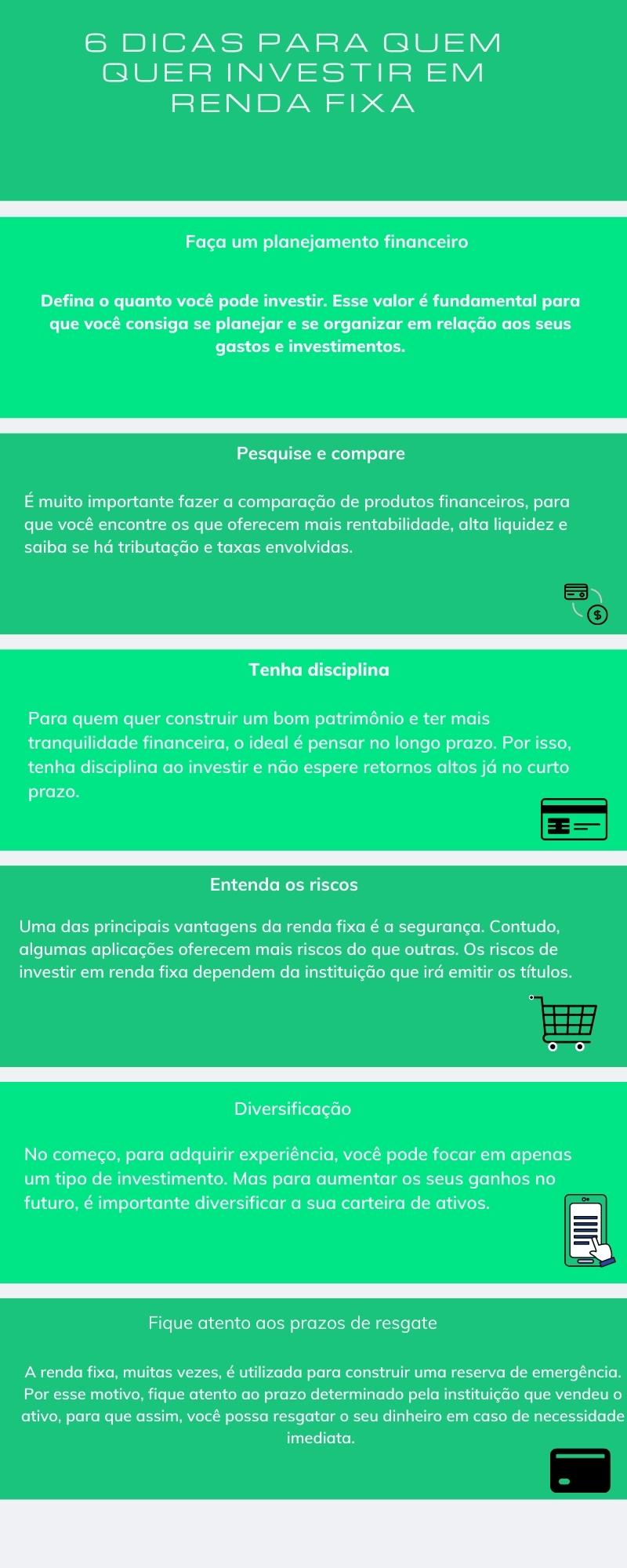
It's important to remember that the more you diversify your portfolio of financial assets, the better!
If you want to know more about fixed income, take the opportunity to read our main content on the subject by clicking here.