
Discover once and for all what fixed income is!
Announcements
If you want to make investments safely and affordably, you need to know what fixed income is!
This type of investment is recommended for more conservative investors, that is, those who prioritize security.
However, even if you have a higher tolerance for risk, it is worth diversifying your portfolio with fixed income products.
With that in mind, we have prepared a complete guide with everything you need to know about the subject.
Below, find out what fixed income is and the main options in this investment category!

What is fixed income?
Fixed income is a type of investment in which profitability is predictable.
In other words, in these applications, at the time of contracting, it is possible to predict the return on investment at the end of the term of that title.
The return can be fixed at a monthly percentage or follow financial indicators, such as Selic and CDI, for example.
There are two types of fixed income investments:
- Prefixed: In this case, the investor will know exactly what the return on the investment will be, as the profitability is fixed from the beginning.
- Post-fixed: In post-fixed investments, the variation depends on the index that the security follows. If it fluctuates, the profitability of the investment will change according to the variation.
What are the main types of fixed income investment?
Among the main fixed income investment options, we can mention:
1. treasury direct
Tesouro Direto is one of the best options for conservative investors.
When you purchase a security from Treasury Direct, basically, you are lending your money to the government in exchange for a remuneration, which you will receive when the bond matures.
This National Treasury program developed in partnership with B3 gained popularity due to the fact that it is a very accessible investment modality.
Currently, with just over R$ 30, you can already purchase government bonds.
The types of public securities available are:
• Pre-fixed Treasury: profitability is defined at the time of investment.
- Selic Treasury: It is a government bond whose profitability is linked to the Selic, the economy's basic interest rate.
- IPCA Treasury: It is a hybrid security. Part of its remuneration is post-fixed, since it follows the IPCA, and the other is prefixed.
2. CDB (Bank Deposit Certificate)
CDB is a fixed income security issued by banks to raise funds and finance their activities.
It works very similarly to Tesouro Direto. The difference is that in this case, you are lending your money to financial institutions.
In return, you will be paid interest on the set date.
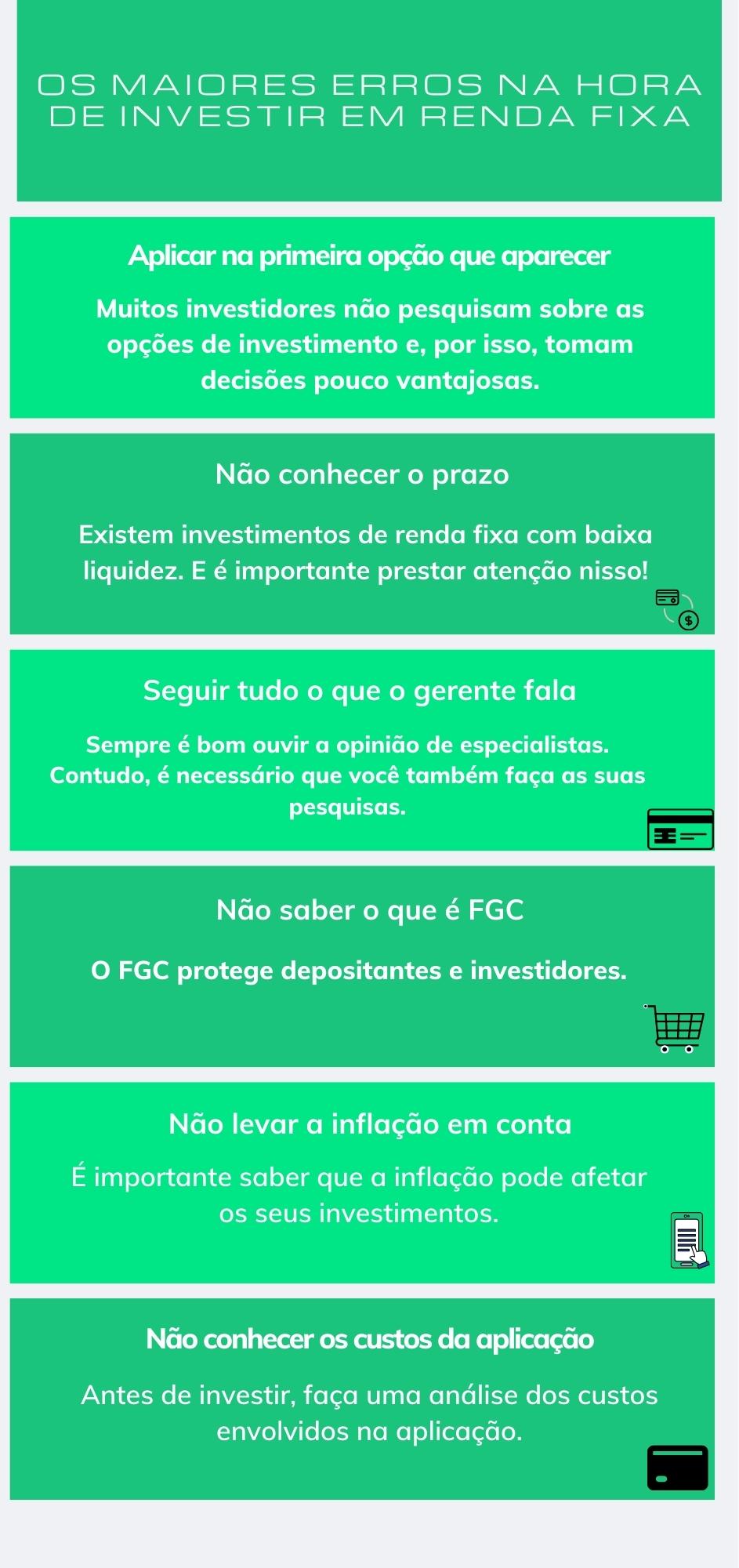
It is considered a safe investment, as it has the protection of FGC (Credit Guarantee Fund).
The yield on a CDB is higher than that of a savings account. Therefore, it is a good option for those looking for low-risk investments with good profitability.
But before investing in a CDB, it is important to pay attention to the term, as they vary from issuer to issuer and from title to title.
It is possible to find CDBs with daily liquidity (so you can withdraw whenever you want) or even with a grace period, for those who intend to invest with a long-term view.
3. LCI and LCA
Real Estate Credit Letters (LCI) and Agribusiness Credit Letters (LCA) are investments exempt from Income Tax.
The only difference between LCI and LCA, basically, is the investment focus.
However, in practice, their operation is very similar, since both LCI and LCA are exempt from IR, have a FGC guarantee and have a return that can be prefixed or post-fixed.
In addition to the FGC, it is important to make sure that the institution issuing the letter of credit has a good risk rating – rating call.
The rating is a grade that credit rating agencies assign to the issuer. The higher the rating, the lower the security risk.
4. Bills of exchange
Despite the name, Bills of Exchange (LC) have nothing to do with foreign currencies, such as the dollar, for example.
LCs are securities that financial institutions issue with the aim of raising funds from investors to lend to customers.
In other words, when you purchase a bond, you are lending your money to the issuing company. In return, you will receive the amount plus interest.
The remuneration of LCs may have a post-fixed, prefixed or hybrid rate.
It is an investment with good profitability and considered safe, as it is possible to find securities protected by the FGC.
The taxation that applies to LCs is the same as that of CDB: Income Tax.
This is a regressive tax. This means that the longer the investment period, the lower the percentage of tax paid.
5. CRI and CRA
Real Estate Receivables Certificates (CRIs) and Agribusiness Receivables Certificates (CRAs) are two fixed income investments exempt from Income Tax.
They are similar to LCIs and LCAs. The main difference is that receivables certificates are issued by securitization companies.
Furthermore, CRIs and CRAs are not protected by the FGC.
One of the main advantages of this type of investment is profitability. Although these securities offer the predictability of fixed income, there are chances of earning more than with other, safer investments.
In terms of risks, the main one is default by the borrower, as CRI and CRA are not protected by the FGC.
These investments are best suited for the long term. In fact, it is quite common to find assets with maturities of five years or more.
Conclusion
Now you know what fixed income is and the main applications available on the market.
The advantage of this category of investments is that it offers stable and recurring returns.
For this reason, fixed income products are highly sought after by conservative investors and beginners!
If you liked this article, be sure to share it on your social networks!