

But what is fixed income investing after all? Learn in detail the main characteristics of this type of investment!
Announcements
Fixed income investment is one of the most sought after by investors looking for more security and stability.
It’s a great option for those who are just entering the world of investments and don’t yet have an emergency fund.
But do you know exactly how fixed income works? What are its advantages and disadvantages?
To find out more, read on.
How does fixed income work?
Fixed income is a type of investment in which profitability is predictable.
The rate of return and maturity date are established at the time of application.
Basically, it works like this: when you buy a fixed income security, you “lend” your money to the bank or financial institution in question.
In return, you receive a profitability rate, which, as you already know, is agreed upon at the beginning of the contract.
Banks need to raise funds to finance projects or develop specific areas, such as agribusiness, for example.
This means that when you acquire a fixed income security, in addition to earning money, you also contribute to the growth of sectors that are important to the country's economy.

What is the difference between fixed income and variable income?
The main difference between the two types of investments is risk.
When investing in fixed income, the investor already knows from the beginning what the rules for income and the maturity date are.
In variable income, it is not possible to define a fixed gain, as the profitability of the money can vary upwards or downwards.
Fixed income investments are considered safer. However, the profitability ends up being lower.
Investments in variable income, on the other hand, usually offer more significant gains. However, the risks involved are slightly higher.
What are the types of fixed income investments?
There are basically three types of fixed income investments. They are:
- Fixed-rate securities: In the prefixed modality, the yield of the security corresponds to a fixed interest rate defined at the time of application. The rate does not change until maturity.
- Fixed-rate securities: are always linked to an index. For example, if the Selic rate is an index and it rises, the bonds follow the same movement.
• Hybrid securities: As the name suggests, the third type of investment has a fixed part and a variable part. They are highly sought after by investors looking for returns above inflation.
What is the fixed income yield?
Despite the name, fixed income investment varies depending on the security chosen.
The main reference for this type of investment is the CDI (Bank Deposit Certificate) which follows the interest rate.
The minimum return that an investor normally expects is 100% of the CDI. However, if the investment is tax-exempt, the security may yield less than 100% of the CDI.
This means that if you invested your money and had a lower return than this, the investment performed below the main market reference.
It is important to remember that there are fixed income investments that yield much more than the CDI. However, in these cases, you may have to give up the term, liquidity or be willing to take slightly greater risks.
What are the main advantages of investing in fixed income?
The main advantages include:
Security
Most fixed income investments are as safe (or even safer) than a traditional savings account.
After all, a good part of these investments are guaranteed by FGC (Credit Guarantee Fund) for values up to R$ 250 thousand.
This means that if the issuer of the bond goes bankrupt, you will not lose the amount invested.
Furthermore, fixed income returns are more stable and have low financial risk.

Liquidity
Liquidity refers to the potential an asset or investment has to be converted into cash.
The greater the liquidity, the easier it will be to redeem.
A good example of a fixed income investment with high liquidity is the National Treasury, which has public securities with daily liquidity and, therefore, low liquidity risk.
Ease
Investing in fixed income is much easier than you think!
Trading is done entirely online. In other words, you can invest your money without leaving your home. In addition, you don’t need to monitor your investment every day.
Basically, all you need to do is buy the bond and wait for the maturity date.
When that day comes, you will receive your money and income, as defined at the time of contracting.
Exemption
Some fixed income investments are exempt from income tax, which is the case with LCI and LCA.
This way, all the income goes directly into your pocket.
What are the main disadvantages of fixed income investing?
As you can see, there are several advantages to fixed income. However, there are also disadvantages. They are:
Low financial return
Typically, fixed income investments offer low financial returns, i.e., lower profits than variable income investments.
Of course, depending on your investor profile, The low yield may even be worth it. After all, fixed income is safe, stable and almost always has high liquidity.
Shortage
There are fixed income investments that require a grace period for redemption.
In this case, if you want to withdraw the money invested, you will have to pay a fine, with significant losses in profitability.
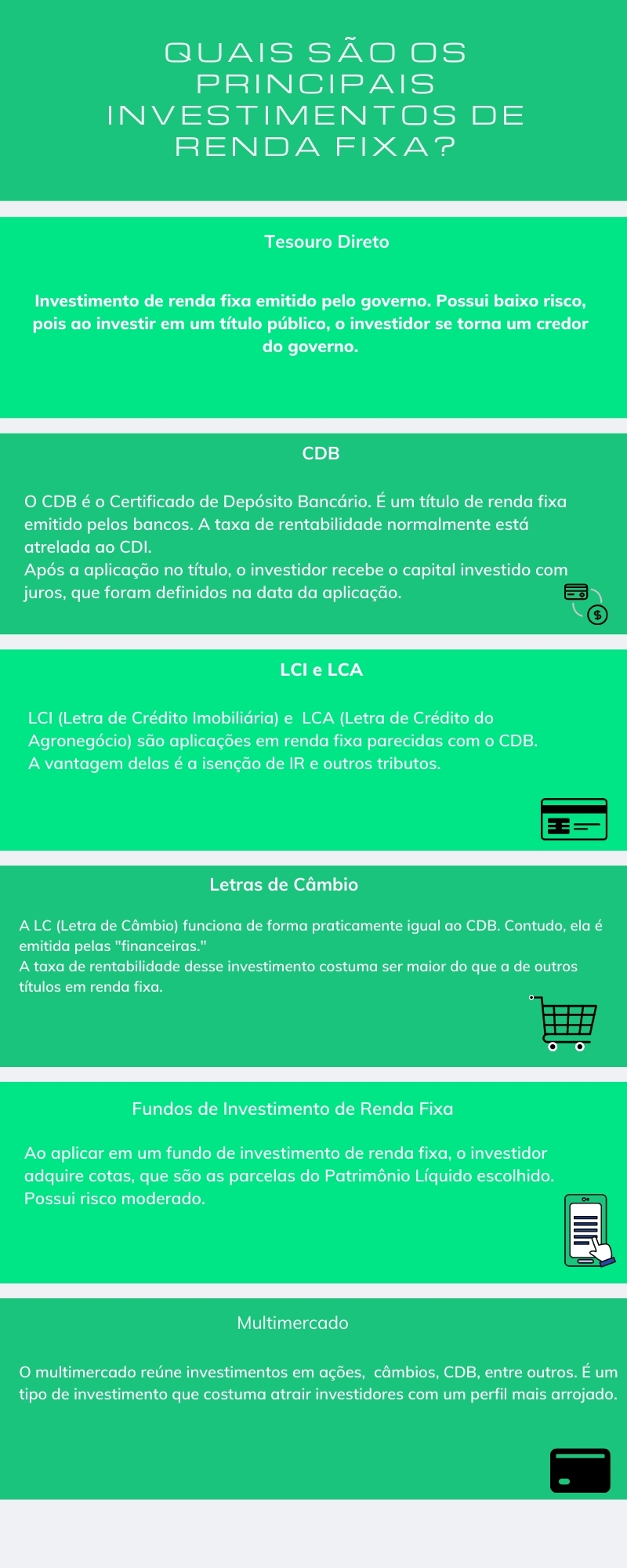
Conclusion
Investing in fixed income is a great option for those who are starting to invest and prioritize security, stability and liquidity.
In any case, investments in this category should be present in every investor's portfolio. After all, even if you are already an experienced investor and have a bold profile, it is important to diversify your portfolio.
If you want to know more about fixed income, take the opportunity to read our main content on the subject by clicking here.