
The Financial Letter is a type of fixed income investment that usually has better returns
Announcements
The Financial Letter is a fixed income investment with longer terms and attractive profitability.
In other words, it is an interesting type of investment for those who are looking for a more stable return and can maintain the investment for a long period.
And if you are interested in this type of fixed income investment, continue reading. Below, we will explain how this financial product works!

What is a Financial Letter?
The Financial Letter is a type of investment that works like other fixed income securities.
This means that when you make this type of application, you are, in fact, lending your money to a financial institution.
The remuneration rules are defined at the time of the title. Therefore, when choosing this application, you will know exactly what index is used for yield.
However, there is a certain factor that differentiates LFs from others. fixed income investments: the longest application period, which is usually at least two years.
Who issues the Financial Letter?
According to Resolution No. 4,733 of June 27, 2019, the title can be issued by authorized financial institutions, which wish to raise long-term resources.
The institutions that can issue Financial Letters are:
· Multiple banks;
· Commercial banks;
· Development banks;
· Investment banks;
· Credit, financing and investment companies;
· Savings banks;
· Mortgage companies;
· Real estate credit companies;
· Credit unions;
· The National Bank for Economic and Social Development (BNDES).
How do Financial Letters work?
This type of investment has its own characteristics.
And if you are interested in this type of application, you need to know what they are.
As you already know, we are talking about an investment alternative for the medium and long term, as the minimum redemption period is two years.
Generally, it pays post-fixed interest linked to and tied to the CDI rate (Interbank Deposit Certificate). The CDI is a rate that varies every business day.
However, there are bonds that offer fixed remuneration.
There are also financial notes linked to the Broad National Consumer Price Index (IPCA), which helps protect your money from inflation and thus maintains its purchasing power in the long term.
Therefore, it is worth counting on the work of specialized professionals to help you understand which is the best option for your portfolio and, thus, maximize financial returns.
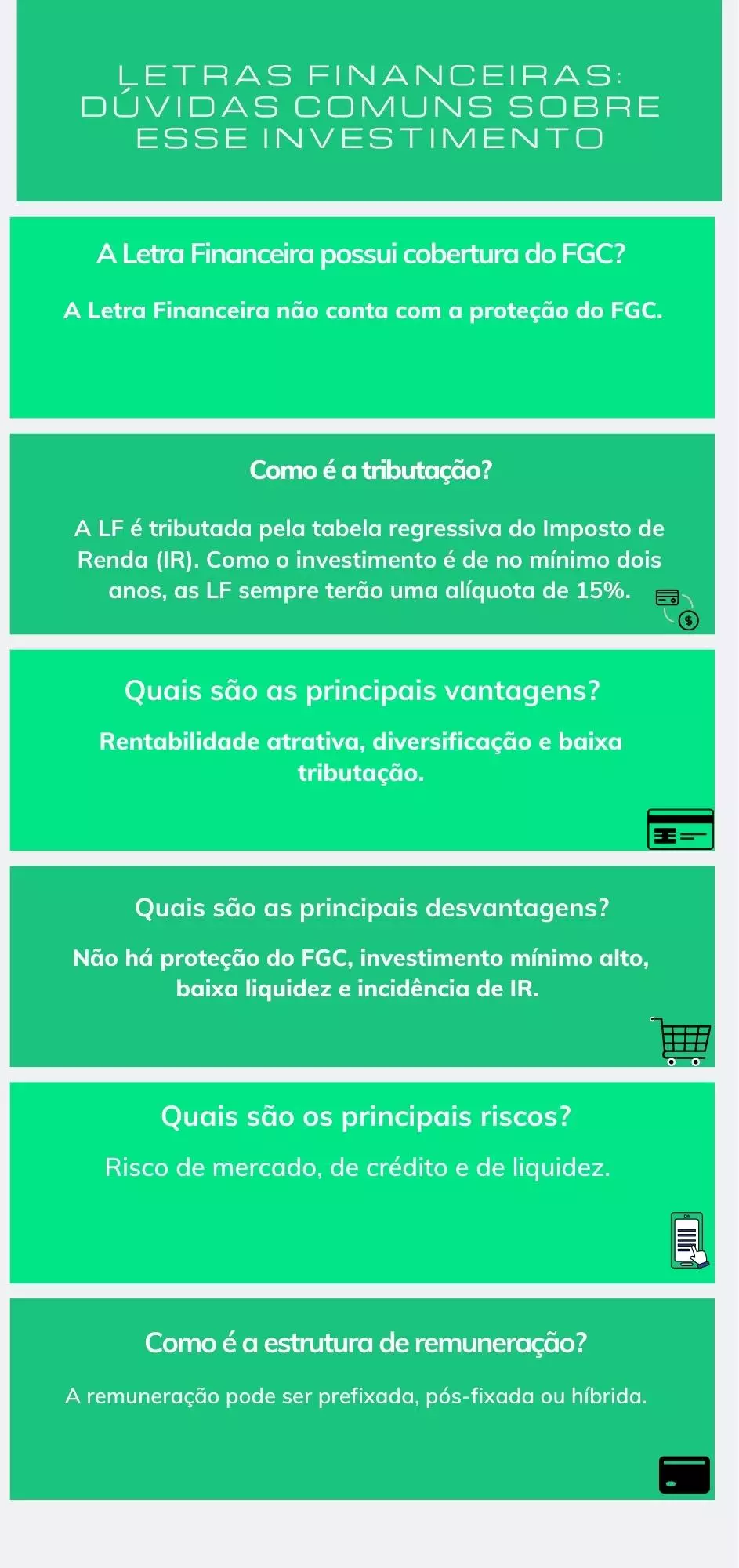
Unlike other fixed income investments, such as Bank Deposit Certificate (CDB), for example, LF is not covered by FGC.
In other words, you depend on the solidity of the financial institution that issued the title.
For this reason, it is important to be even more careful before making an investment. The ideal is to do research and study the solidity of the financial institution and its credit history.
What is the minimum investment and term?
Fixed income securities work in a similar way: you lend your money to an institution (or the government), and, on the agreed date, you will receive the money plus interest.
However, each fixed income security has a different profitability rate, term and minimum value.
In fact, this is one of the disadvantages of Financial Letters. The minimum investment amount is R$50,000. Therefore, it is not an accessible investment for beginner investors.
Regarding the term, the minimum defined is withdrawal two years after the investment. However, there are longer terms.
It is important to remember that as we are talking about an investment with low liquidity, the Financial Letter is not an investment recommended for those who wish to create a emergency reserve.
After all, if your intention is to create a reserve fund to use in the event of unforeseen events, the ideal is to look for an application with daily liquidity.
What is the profitability like?
The profitability of the Financial Letter is similar to that of other fixed income assets, although it may be a little more attractive.
In general, LF is interesting for investors of all types (conservatives, moderates and bold).
For more conservative investors, the financial letter can be a good option to withdraw from savings.
Moderate and bold investors, on the other hand, normally invest in financial notes to diversify their portfolio.
However, remember that in addition to the investor profile and the profitability of the investment, before making any investment, it is also important to define your short, medium and long-term financial objectives.
For example, if you intend to save and invest to take a trip in a few years, a financial letter may be an interesting option.
However, if you want to create your emergency reserve or have a very short-term goal, LF is not a recommended option, as it is a low-liquidity asset.
What are the main advantages of Financial Letters?
The Financial Letter offers slightly more attractive return rates than other fixed income investments.
Therefore, it is an interesting option for those who want to diversify their portfolio and avoid low savings returns.
Furthermore, it offers predictability, since at the time of contracting, the investor can estimate how much he will receive within the defined maturity period.
What are the main disadvantages of Financial Letters?
LFs are not covered by the Credit Guarantee Fund (FGC) up to the limit of R$250,000 per CPF or CNPJ.
Therefore, the biggest risk of this application is the possible bankruptcy of the institution that issued the title.
For this reason, it is essential to choose solid and renowned institutions in the market.
It is also important to mention the impossibility of redemption before maturity and the incidence of Income Tax (IR).
Conclusion
The Financial Letter is a long-term fixed income investment that offers more attractive returns.
Therefore, it is not a suitable option for those who have short-term goals or want to create an emergency fund.
Before investing in a Financial Letter, it is necessary to establish objectives, understand your investor profile and analyze all the characteristics of the security – form of remuneration, maturity date, minimum value, among others.