

The Future of Work: Essential Skills in the Age of AI!
Announcements
Automation will replace 60% of current jobs with repetitive tasks by 2030.
Will you thrive in a world where machines do more?
Our era of technological innovations, with AI and automation, is changing the job market. Human skills are now more valued.
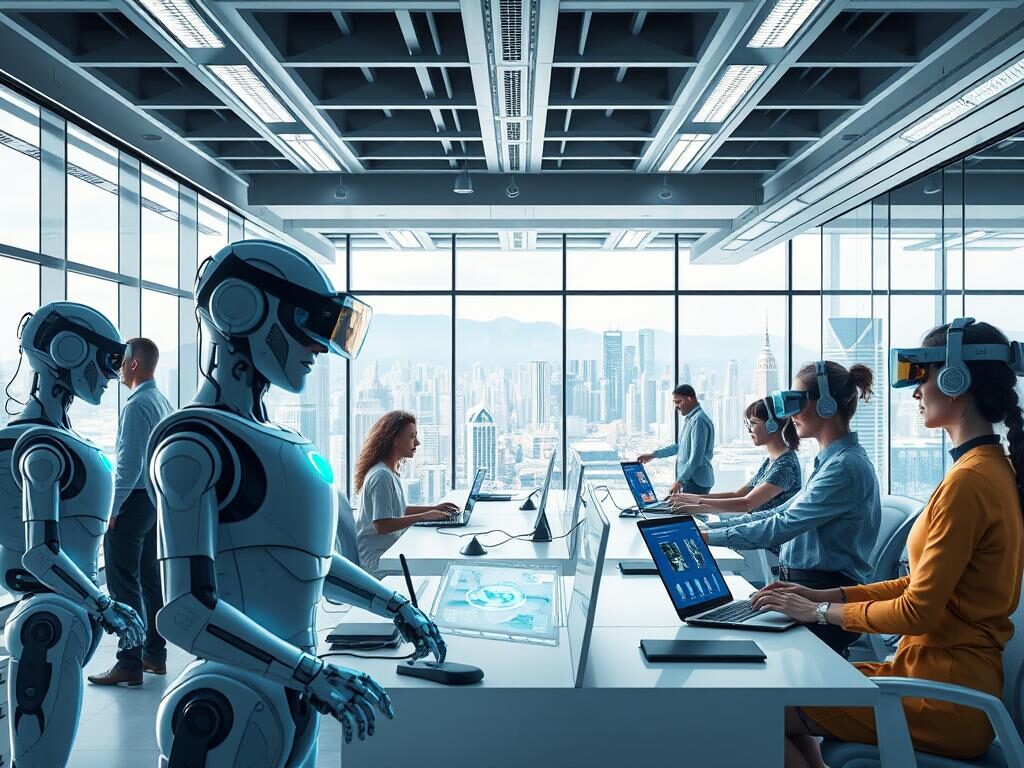
Professions that require creativity, critical thinking, empathy and the ability to interact with people are on the rise.
Communication and leadership will be essential in 75% of vacancies by 2030.
Machines still can't do this as well as humans.
Furthermore, 85% of companies want to invest more in AI and machine learning by 2025.
To stay relevant, it is crucial to continually learn.
Professionals who seek to learn are 30% more likely to be hired.
Main Conclusions
- Automation is expected to replace 60% of today's jobs with repetitive tasks within the next two decades.
- 85% of companies plan to increase their investment in machine learning and AI by 2025.
- Professionals who seek to learn continuously have a 30% higher employability rate.
- Soft skills will be in demand in 75% of job openings in automated sectors by 2030.
- Continuing education is crucial to maintaining professional relevance.
Impact of AI on the Job Market
Artificial intelligence is changing many industries.
It makes repetitive and dangerous tasks automatic.
This leaves workers free to focus on more creative things.
A report by the World Economic Forum says that 231,000 jobs will change with AI.
The most repetitive tasks are the ones most affected by automation.
On the other hand, AI is creating new professions.
There is more demand for AI experts and machine learning engineers.
Automation is compared to the Industrial Revolution for its changes in the job market.
Furthermore, the shortage of technology professionals is growing. This is because the demand for these specialists is increasing.
++ The Future of Work: professions that will be on the rise in the next 5 years
By 2030, 14% of the global workforce may need to change categories.
It is estimated that 400 to 800 million jobs could be automated by 2030.
The most affected areas are industry, financial services and healthcare. This shows a major shift in efficiency and automation.

AI is also improving healthcare. It can replace administrative functions.
The demand for STEM skills is growing, showing the need for qualified professionals.
AI is becoming more accessible across a variety of industries. This is improving the effectiveness of day-to-day operations.
| Area | Transformation | Expected impact |
|---|---|---|
| Industry and Manufacturing | Process automation | Increased operational efficiency |
| Financial Services | AI in data analysis | Improved accuracy of financial decisions |
| Health | Medical care and treatment | Improving clinical results |
Companies of all sizes are embracing AI and automation. This can lead to a more skilled workforce.
The evolution of AI can revolutionize sectors such as transportation, healthcare and banking, promoting innovation and efficiency.
The Importance of Soft Skills in the Age of AI
With automation increasing, interpersonal skills and emotional become essential.
The soft skills, such as empathy and critical thinking, complement machines.
Emotional resilience can increase productivity by up to 25% during times of change.
These skills are crucial in sectors such as healthcare and education, where human interaction and personal judgment are key.

A emotional intelligence is linked to adaptability.
Professionals with high emotional intelligence feel more prepared for technological changes.
Effective communication is vital to sharing AI discoveries with non-technical people.
Versatile professionals who adapt quickly are 40% more likely to be promoted. This shows the importance of adapting to new demands.
According to leaders, the need for soft skills increased with AI.
However, only 35% of workers feel prepared for these skills.
A willingness to learn is essential, with 70% of employers looking for adaptable candidates.
Creativity is crucial, with 751% of employers valuing the ability to innovate.
Companies with well-developed employees in soft skills improve results and relationships.
This shows the importance of these skills in a world of fast AI.
++ What is Return on Equity (ROE)?
Essential Technical Skills in the Age of AI
In addition to the soft skills, it is essential to have technical skills in the age of AI.
Skills such as schedule, data analysis and STEM knowledge are crucial. They give you a competitive advantage in the job market.

70% of companies see the schedule as essential. 61% of professionals want to know more about machine learning.
And 54% of companies using AI need Deep Learning experts.
A data analysis is also vital. 82% of managers think Big Data is crucial to decision making.
And 75% of the market wants people with knowledge in Cloud Computing to improve AI projects.
Announcements
| Ability | Importance |
|---|---|
| Programming | Essential for 70% companies |
| Machine Learning | Desired by 61% of professionals |
| Deep Learning | Required for 54% of companies |
| Big Data | Crucial for managers' 82% |
| Cloud Computing | Required by 75% market |
In a world full of Big Data and cloud computing, it is crucial to have these skills.
Professionals who master these areas are ready to lead the transformation at work.
Have these technical skills can put you ahead in the technology race.
Essential Skills in the Age of AI
To stand out in the future of work, it is crucial to learn and adapt to new technologies.
Skills such as flexibility, resilience and creativity are essential.
Professionals must know how to use new technologies while maintaining human skills that complement AI.
The data shows that adaptation is urgent.
For example, only 5% of Brazilians speak English, and 3% speak it fluently.
This shows the importance of continuous learning to remain competitive.
Managing the Office package and knowing how to deal with data have become essential at work.
The experience of learning on your own, such as in BI via YouTube, shows the importance of being adaptable and willing to learn.
Specific skills, such as SQL, are increasingly valued. soft skills as a curiosity are gaining prominence.
The ability to learn and adapt quickly is as important, if not more important, than formal qualifications.
| Statistic | Percentage |
|---|---|
| HR Executives Believe There’s a Digital Skills Gap Due to AI | 43% |
| HR managers who think AI has created fear among employees about losing their jobs | 58% |
| Employees who have received AI training | 14% |
| Employees who estimate that most of their daily tasks will be performed by AI | 76% |
| Employees who fear being replaced by AI | 44% |
| AI users who don't completely trust the tools' results | 95% |
These numbers show the importance of adapting and being creative in the new era.
Have a mindset of continuous learning is essential to stay relevant and competitive, especially in a market dominated by AI.
Essential Skills in the Age of AI: Conclusion
The AI era brings challenges, but also opportunities to change careers.
To stand out in the future of work, it is important to have technical skills and interpersonal.
Investing in education and being flexible are essential steps to success.
In Brazil, the IT sector is important, contributing 6.5% to GDP. But it faces challenges, such as more layoffs.
However, there is a lot of demand for AI skills like machine learning.
Professionals who know how to use TensorFlow, PyTorch, and scikit-learn have an advantage.
Adaptability and resilience are highly valued today.
Having the ability to innovate and solve complex problems helps a lot.
Investing in career in the AI era, improving technical skills and interpersonal, is crucial to success.
++ What is a Circuit Breaker and How Does It Affect Your Investments?