
Do you want to get out of savings, diversify your fixed income income and don't know where to start? The best option is to invest in fixed income investment funds. Find out everything now!
Announcements
Investments in fixed income funds offer a higher return than savings accounts at a considerably controlled level of risk compared to other financial assets.
Fixed income funds are interesting due to their simple analysis and the lack of many particularities that need to be observed for their application.
In this article, we will talk about the entire operating mechanism and characteristics involved in this very successful investment method. This way, you will know exactly:
- What are fixed income funds?
- How do fixed income funds work?
- What are the advantages?
- What are the disadvantages?
- Profitability
- Types of fixed income funds
- How to invest?
- 10 Most Profitable Fixed Income Funds of 2021

What are fixed income funds?
Fixed income funds are investment portfolios with fixed equity of 80% or more in assets subject to changes in the interest rate, price index or both.
They basically operate with fixed income securities. Therefore, those who make this investment lend money to receive interest in the short and long term.
The titles of the Treasury Direct, CDBs, LCIs and LCAs, among others, are issued to raise funds from investors to the government, banks and financial institutions or companies.
The profitability of the investment comes from these transactions. Securities with higher credit risk (variable income) and derivatives can be added to this investment to increase its profitability and protection.
How do fixed income funds work?
Fixed income funds bring together resources from different investors with a more conservative profile who want to invest in the market with greater security.
In this way, your earnings are shared among the fund participants according to each one's share in the fund's total.
Shares are fractions of participation in the fund. If you want to invest R$ 12 thousand in a portfolio with shares worth 24.00, you will be buying 500 shares.
Investment management is carried out by a professional manager, who makes decisions in accordance with pre-established policies. When investments are profitable, their shares increase in value and become more expensive.
What are the advantages?
There are several advantages to choosing to invest in a fixed income fund instead of other funds or investments, such as diversification and professional management. Let's talk about these points and others.
Easy access
Investment in fixed income funds has minimum investments that make the investment accessible to beginner investors or those with low investment potential, unlike other market modalities.
Professional management
Outsourcing the management of the portfolio where you are placing your money to a specialized team with years of experience in the market provides additional validation of the security of the investment.
Transparency
Investment funds must make available in their regulations their investment policy, risk level and exposure of certain assets invested in the portfolio. Such regulations can be consulted by any investor on the CVM website,
Security
Fixed income funds are more conservative than equity, multimarket or mixed funds, as they have defined remuneration rules from the start of the investment.
After all, a fixed income fund predominantly brings together government bonds and bonds guaranteed, up to a certain limit, by the Credit Guarantee Fund.
This scenario is very different from buying shares on the Stock Exchange, when we have no way of knowing whether the shares we acquire will increase in value or not as the weeks and months go by.
Good liquidity
Withdrawing your resources from an investment fund at any time is quick and practical.
What are the disadvantages?
Income
Fixed income funds offer lower returns than equity funds, real estate funds or multimarket funds, among others. These options have greater potential for gain and therefore greater risk. In fact, fixed income funds are not always profitable.
Debentures, for example, are fixed income investments that are not guaranteed by the FGC. Thus, if a company in which the fund has investments defaults and does not pay the interest on its securities, the fixed income fund manager will have to account for this loss, and in addition to the drop in investors' income, their shares will suffer devaluation.
Lack of autonomy
By leaving the management of your resources in the hands of a specialized manager, you lose the decision-making power in choosing which assets to purchase.
Costs
When investing in investment funds, it is necessary to observe the rates and their influence on reducing the return on the investment.
These fees are discounted from the gain obtained from the appreciation of the shares. When running an investment simulation on the platform of your stockbroker, for example, the investor will be able to measure the net profitability obtained with this discount.
The fee that is most regularly charged on fixed income funds is the management fee.
It is related to the maintenance of the investor's assets and the cost of administration services. Although it is an annual fee, its charge is diluted proportionally throughout the days of the year.
At a time when the economy's basic interest rates are at a record low, if a fund charges 2% per year in management fees, for example, its investment is not advisable. Since its net return after deducting taxes and inflation will be close to zero.
As for the performance fee, which would be a bonus paid to the fund manager for achieving a gain above a pre-established reference index, it has limitations for fixed income funds.
A Securities and Exchange Commission (CVM) determines that this fee may only be charged when the fund is intended for a qualified investor, when the fund is classified as “long-term” for tax purposes or as “fixed income – external debt”.
Taxation
The taxes levied on fixed income funds are the Tax on Financial Transactions – IOF and the Income Tax – IR. The IOF is only charged when the investment is withdrawn within the first 30 days after the start of the investment. The IOF rate on income is between 0% and 96%.
O Income Tax is levied on the profitability of your investment regardless of of the time that the investor keeps his resources invested. Here, the rate decreases over the application period.
Fixed income funds with securities that mature in less than 365 days (considered short-term for tax purposes) are subject to a rate of 22.5% if the redemption is made within 180 days of application and 20% for redemptions after 180 days.
Funds with securities that mature in more than 365 days (considered long-term for tax purposes) are subject to income tax as per the table:
| Up to 180 days | 22,5% |
| From 180 to 360 days | 20% |
| From 361 to 720 days of application | 17,5% |
| Over 720 days of application | 15% |
As we can see, the income tax rate changes every six months and the tax is charged every six months. This charge is known as “come-cotas” (withholding tax), since it is carried out by collecting the fund’s shares.
If the investor wishes to withdraw the investment before the due date, while the IR rates are higher than those collected in the come-cotas, the difference between what has already been discounted and the balance to be discounted is retained.
Profitability
The profitability of fixed income funds varies greatly and is subject to the policy employed by each fund to generate greater gains.
Some funds also use credit securities and leverage to increase their results. Therefore, it is advisable to observe the profitability history, the risk of the fund and how much credit or leverage it uses before investing.
Fixed income funds typically present a variation in profitability between 90% and 110% of the CDI, which may be higher or lower. Negative returns are very rare.
Types of fixed income funds
Fixed income funds are classified according to the assets chosen for investment and the policy adopted. We can consider four distinct types.
Simple Background
The simple fixed income fund is the easiest, safest and most accessible option for investing in fixed income funds. This portfolio has at least 95% of its resources invested in Treasury Direct bonds.
Repurchase operations involving only federal government bonds and bonds from financial institutions with low credit risk can also be acquired by this fund.
In order to facilitate membership in this type of fund, its documents and information are available mainly on the internet. The investor also does not need to sign a membership and risk acknowledgment form to invest, nor go through a profile identification process, which is normally done by banks and brokerages.
Short Term Fund
Short-term investment funds are also quite conservative options. However, here you can buy securities other than Treasury Direct, which are considered to have low credit risk by the fund manager.
Shares of index funds that invest in low-risk public and private securities and committed operations with public securities can also be acquired.
Referenced Fund
This fund tracks the variation of a reference indicator (benchmark) represented by a market index or an interest rate.
The best-known referenced fund is the DI fund, which follows the daily variation of bank interest rates and is based on the Interbank Deposit Certificate rate – CDI.
A portfolio of referenced funds must maintain 95% of its resources invested in securities that follow the indicator and at least 80% in Treasury Direct bonds, from companies with low credit risk or index funds that invest in both categories.
External Debt Fund
This fund has at least 80% of its resources invested in Brazilian external debt securities.
With the exception of very specific cases indicated in the regulations – such as the allocation of surplus resources in derivatives operations aimed at protecting the portfolio – this portfolio cannot invest in national securities.
How to invest?
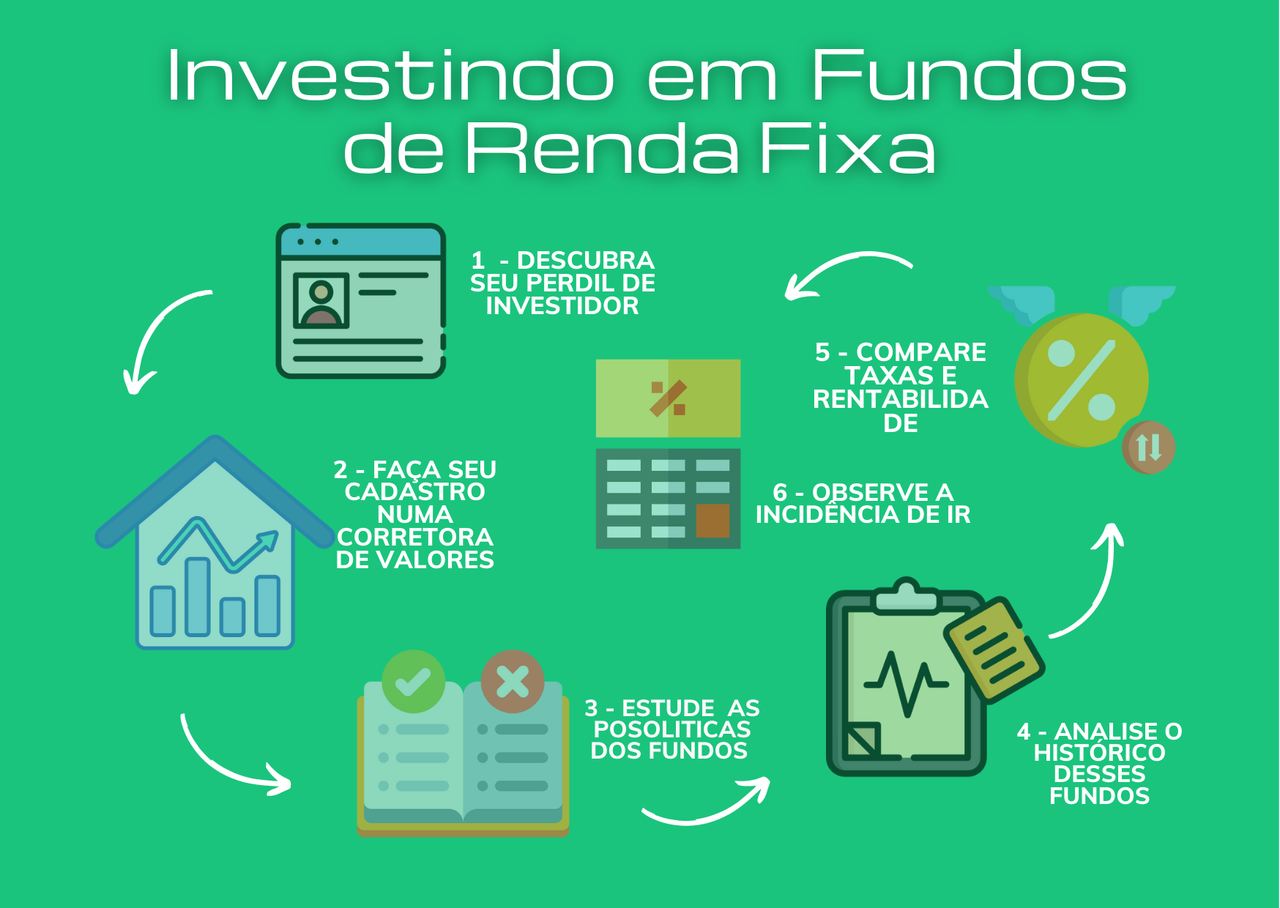
See now the step-by-step guide to analyzing and investing in fixed income funds.
1 – Discover your investor profile
This will help you determine which fixed income investments and fixed income funds are ideal for achieving your goals. Or, better yet, whether it is interesting for you to diversify your resources into more investment options such as stocks, real estate funds, etc.
2 – Register with a stockbroker
3 – When checking the available investment funds, study the policies of these portfolios, which are found in their regulations;
4 – Analyze the fund’s history
Always monitor the performance of your earnings during market highs and lows, the fund's liquidity and redemption conditions, and its position in performance rankings. A comparison with another manager's portfolio is very welcome.
5 – Make a comparison between management fee and profitability that the fund has been performing. Perform this analysis on all the funds that interest you.
6 – Don’t forget that the taxation of fixed income funds by Income Tax decreases over time according to a regressive table, and hold your investment as long as possible or until maturity date.
10 Most Profitable Fixed Income Funds of 2021
Quantum Finance, according to Valor Investe indicated the 10 most profitable fixed income funds in 2021.
However, we cannot say that the funds listed below are the best ones for your investment. As we said, you need to find out what your investor profile is and then make the best choices.
| Position | Fund Name | Anbima Classification | Profitability (2021) | Volatility (aa) | Profitability-Risk Coefficient |
| 1 | FL PREMIUM INSTITUTIONAL FI FIXED INCOME LP | Free Duration Free Credit | 65,4 | 39,6 | 1,65 |
| 2 | IRON FUND RPC FI FIXED INCOME PRIVATE CREDIT | Free Duration Invest Grade. | 24,3 | 27,9 | 0,87 |
| 3 | IRON FUND 2 TWC FI FIXED INCOME PRIVATE CREDIT | Free Duration Invest Grade. | 24,3 | 30,5 | 0,80 |
| 4 | SAS FI FIXED INCOME | Free Duration Invest Grade. | 17,3 | 3,8 | 4,61 |
| 5 | PETROS RECOVERY FI FIXED INCOME PRIVATE CREDIT | Free Duration Free Credit | 17,0 | 84,5 | 0,20 |
| 6 | FÊNIX FI FIXED INCOME PRIVATE CREDIT | Duration High Invest Grade. | 16,8 | 32,9 | 0,51 |
| 7 | BRADESCO TOUCAN XXXI REC FI FIXED INCOME | Duration High Invest Grade. | 16,4 | 3,7 | 4,45 |
| 8 | SULAPREVI INDIVIDUAL FI FIXED INCOME | Free Duration Sovereign | 16,3 | 3,6 | 4,47 |
| 9 | BRAM H SENA FI FIXED INCOME | Free Duration Free Credit | 16,1 | 6,5 | 2,49 |
| 10 | SULAMERICA SAP GROUP FI FIXED INCOME | Free Duration Free Credit | 15,8 | 3,6 | 4,35 |
Conclusion
If you are an investor who wants to take on low risk and have gains above the CDI, investing in fixed income funds is for you.
The risk here is exclusively linked to investments in credit securities, which make up between 0% and 20% of the fund. Therefore, if the company (or companies) transferring the credit security fails to pay its debts, the fund's profitability is negatively impacted.
Take advantage and also read: “Selic Treasury, how does it work? Get your questions answered!”. Click the button and find out more!