

Do equity funds pay dividends? That's what you're going to find out now!
Announcements
Equity funds are an excellent option for those who want to invest in variable income, but do not yet have much experience in the stock market.
In other words, it is a simple way to operate on the stock exchange, but without having to operate on the trading floor.
It is possible to start investing with little money in different types of asset management.
If you want to know more about equity funds and find out if they pay dividends, keep reading. We'll explain everything about the subject!
What are equity funds?
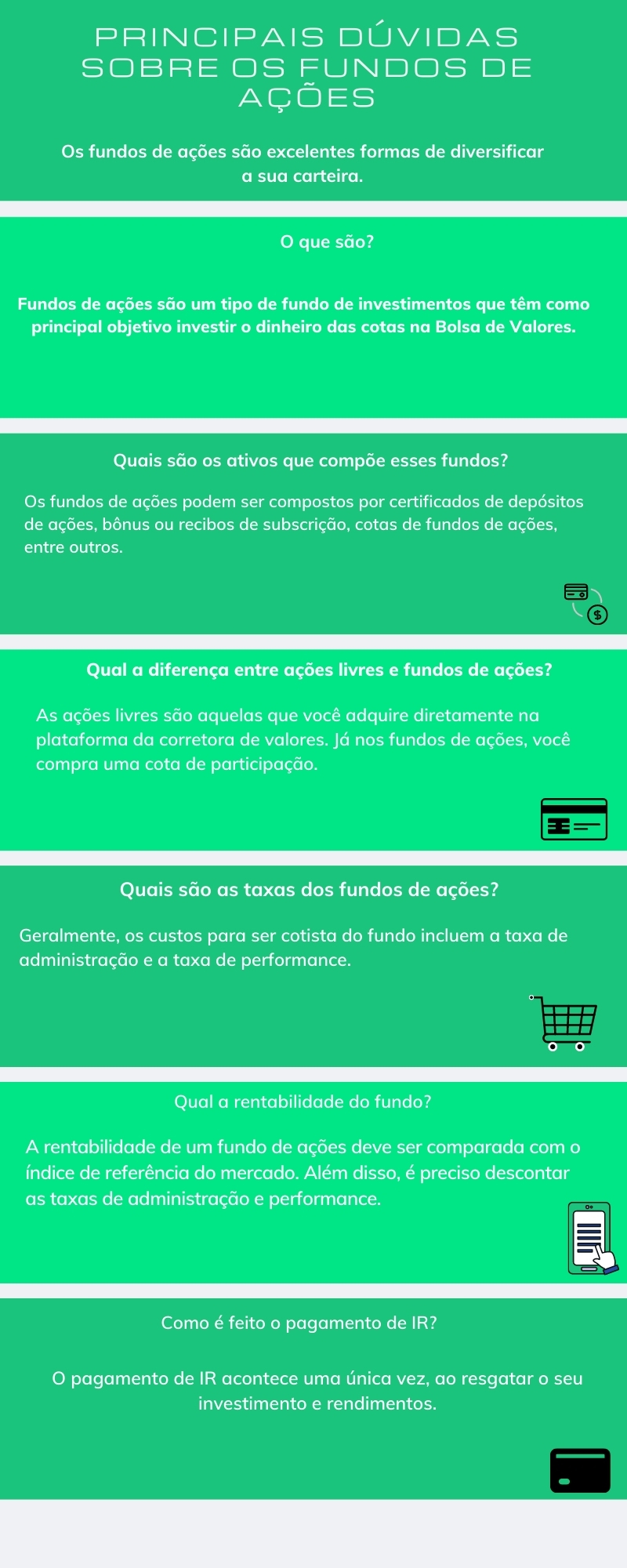
Equity funds They are a type of investment whose main objectives are to outline and invest the resources of shareholders in strategies with assets in the stock market.
By definition, they must invest at least 67% of their equity in shares traded on organized markets, such as the stock exchange, for example.
The remaining third of the net equity can be invested in other financial assets.
Depending on the strategy used, equity funds can generate gains even during periods of decline in the stock market.

What are the main advantages of equity funds?
There are several advantages to investing in equity funds. Among them, we can mention:
• Assistance from a professional manager to choose the best stocks
• Diversification of investment portfolio
• No need to worry about analyzing and choosing stocks to start investing
• Higher profitability than other types of investment, such as fixed income
Is it true that equity funds pay dividends?
Now that you know what equity funds are and the main advantages of this type of investment, it's time to find out whether they actually pay dividends to investors.
To answer this question, we will explain in detail what this type of income means.
It is important for you to know that dividends are the portion of a publicly traded company's net profit that is distributed among shareholders.
This distribution is made based on the class of shares and number of shares that each shareholder owns.
Listed organizations have the right to decide whether to divide profits among shareholders or use them to make new investments in the company.
However, regardless of the choice, companies must share at least 25% of net profit with shareholders and partners.
When you buy a preferred share (one that gives the holder priority when distributing the company's profits), you are guaranteeing your right to have priority in the distribution of dividends.
Thus, the dividends will be deposited into your brokerage account, in accordance with the distribution policy defined by the organization in question.
But when it comes to investment funds, which is the case with equity funds, this practice works differently.

How do equity funds pay dividends?
There are equity funds that are focused on the dividend strategy, as they concentrate their resources in organizations with an excellent dividend yield.
Dividend yield is the indicator that can be used to analyze and choose company shares to invest in.
This rate offers investors the possibility of comparing the dividend yield of one security in relation to others, providing more information to create an investment strategy.
But in practice this does not mean that equity funds pay dividends directly to the shareholder, which is what happens on the stock exchange.
In fact, net profit is the responsibility of the fund manager, who, in most cases, reinvests this amount in shares to generate more impact on the value of the shares.
In this way, the shares increase in value with the income received.
Therefore, there is the possibility of increasing your earnings with equity funds, as the performance of the portfolios improves when reinvesting dividends.
In this case, the dividends will not be credited to the account you have with the brokerage firm, as you will make a profit from the appreciation of the shares.
Therefore, if you want to receive the money directly, you can carry out stock picking: an investment strategy that consists of selecting shares to profit from their appreciation.
And when carrying out stock picking on the stock exchange, you can build your investment portfolio.
But equity funds are there to allow you to leave this work in the hands of a professional manager and, therefore, not have to worry about it.
Is it worth investing in equity funds because of the dividends?
Dividends can be considered a strategy for an equity fund.
There are equity funds that focus on replicating the variations in benchmark indicators in the equity market, investing in companies that demonstrate good levels of corporate security and, of course, investing in shares of companies with a history of good dividend payments.
In other words, there are several criteria to consider when choosing a stock fund. Dividends are obviously one of them. However, they cannot be the only decision factor.
Furthermore, it is important to remember that a fund that receives good dividends from organizations benefits from greater predictability in results.
The reason is that the companies that distribute more dividends are the most solid on the market.
But if you intend to receive dividends periodically to have a source of passive income, equity funds are not the best option.
In this case, it is better to focus on other investments, such as real estate funds, for example.
Who are equity funds recommended for?
Equity funds are great options for investors with a more aggressive profile, that is, those who are willing to take more risks in exchange for high profitability.
However, if you have a more conservative or moderate profile, it does not mean that you cannot invest in equity funds. However, it is important to understand the risks involved.
Conclusion
In Brazil, equity funds generally reinvest the value of dividends in new shares, so that it is possible to increase the positive effect on the appreciation of shares.