
Discover the different types of investments for young people to diversify their portfolio
Announcements
There are different types of investments for young people who want to diversify their portfolio and, therefore, have more financial security and peace of mind in the future.
Nowadays, the financial market is open to all types of people. After all, it is possible to find financial products with different terms, characteristics and profitability rates.
But with so many possibilities, the ideal is to know the main options and start making investments based on your investor profile, objectives and application liquidity.
And if you want to know more about the subject, continue reading and discover the best types of investments for young people.

Young investor: tips for starting to invest
It's never too late to start investing.
Although, the sooner you start making applications, better. The longer the term, the greater the amplitude of compound interest, which will make your assets grow in the medium and long term.
With that in mind, check out the tips we’ve prepared for you, young person, to start investing:
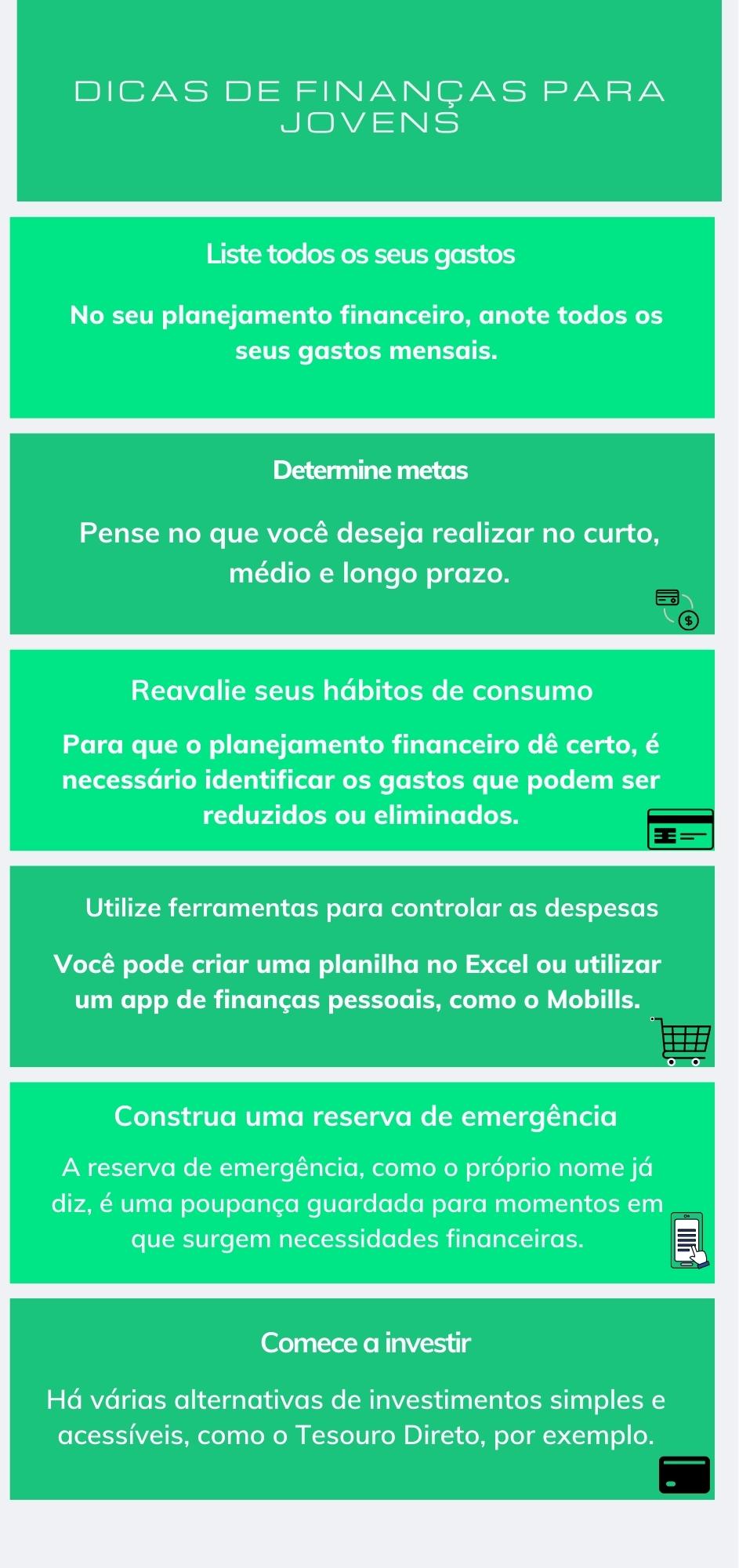
• Make a financial plan: In your planning, define how much you want to save per month. In this part, it is also necessary to identify which expenses can be reduced or eliminated.
• Know your investor profile: The investor profile is an analysis that identifies your main characteristics and preferences regarding investments. Your profile can be conservative, moderate or bold/aggressive.
• Define your financial goals: What do you really want to achieve with your investments? It is very important that you define your goals. After all, this will determine how you will behave in the market.
• Discover the main alternatives: After making a plan and knowing your profile, it's time to start studying the main types of investments and the characteristics of each one.
It is important to remember that once you open your account with a brokerage firm and start making investments, you will need to monitor them frequently.
4 different types of investments for young people
Now that you know the importance of starting to invest and how to do it, it's time to learn about some of the main applications on the market.
Check it out!
Bank Deposit Certificate (CDB)
CDB is a fixed income security issued by banks to raise funds and finance their activities.
In other words, when investing in a CDB, You are lending your money to a financial institution with the aim of receiving future remuneration.
On the agreed date, you will receive your money back plus interest.
Private securities are divided into three categories: fixed-rate, post-fixed and hybrid:
• Prefixed title: interest is negotiated at the time of investment.
• Post-fixed title: the yield is linked to some economic index, such as Selic.
- Hybrid title: profitability is determined by the sum of a fixed rate with a post-fixed rate.

Treasury Direct
Tesouro Direto is one of the most accessible and safe investments on the market.
In fact, with just over R$ 30, you can already start making applications.
The Direct Treasury is a National Treasury Program developed in partnership with B3 for the sale of federal public bonds to individuals. The process works online.
It works in a similar way to CDB bonds. The difference is that when you invest in a Treasury Direct bond, you are lending your money to the government.
These are the Treasury Direct bonds:
- Fixed-rate Treasury: interest rates are determined at the time of contracting.
• Treasury Selic: post-fixed securities whose profitability is linked to the Selic, the economy's basic interest rate.
- IPCA Treasury: profitability is linked to inflation, measured by the variation in the Broad National Consumer Price Index – IPCA.
Although Tesouro Direto does not have the protection of Credit Guarantee Fund (FGC), is considered a very safe financial product, as it is guaranteed by the National Treasury.
Private pension
Private Pension is a retirement that is not linked to the National Social Security Institute (INSS).
It aims to guarantee the beneficiary a future income. For this reason, it is widely used as a retirement plan and is considered one of the best types of investments for young people.
However, it is important to remember that private pension plans can be used for purposes other than retirement.
But how does this investment work?
The investor will hire a private pension plan and start making contributions. The money is allocated to a fund and over time, it will earn interest.
Regarding contributions, there is no mandatory frequency, that is, you can invest whenever you want. However, the higher the contribution, the higher the balance in your pension plan will be.
Some institutions ask for a minimum entry value for the plan, which in these cases, can start with values from R$ 50 or R$ 100, for example.
Letters of credit (LCI and LCA)
Real Estate Credit Letters (LCIs) and Agribusiness Credit Letters (LCA) are fixed income securities exempt from Income Tax.
These bonds are issued with the aim of financing the real estate sector and agribusiness.
It is a profitable and very safe investment, as, like the CDB, it is protected by the FGC.
The disadvantages of letters of credit are the minimum investment amount, which is usually higher (most only accept R$1,000 or more) and low liquidity, which is the ability to convert an asset into cash.
This is not a problem for those who are investing in the long term. However, if you have short-term goals or want to build up your emergency fund, the ideal is to choose a highly liquid investment, such as the Tesouro Selic, for example.
Conclusion
There are several types of investments for young people.
But to find the most suitable option for you, you need to understand your profile and analyze your short, medium and long-term goals.
Furthermore, financial experts recommend diversifying your portfolio, so that you can dilute risks and find good opportunities in the financial market!