
Know how to get out of over-indebtedness and organize your financial life
Announcements
Knowing how to get out of over-indebtedness is a huge challenge for most Brazilians.
The decline in economic growth, the increase in the cost of living and interest rates have made over-indebtedness a problem for millions of people in the country.
In this article, we will explain in more detail what this concept means in practice and, of course, the main ways to avoid this situation or get out of it.
Read on to find out more.

What is over-indebtedness?
Over-indebtedness is the inability to pay financial debts due to the individual's lack of sufficient income.
In other words, it is the accumulation of financial commitments, with the amount to be paid being greater than the monthly income.
Brazilians' debt involves credit card debt, property and car financing, overdrafts and store credit cards.
This can also happen due to other factors, such as job loss or high expenses due to a family illness, for example.
In fact, it is quite common to find friends, family and colleagues in our social circle who are with debts which become unpayable due to the incidence of fines and interest.
Who can be considered over-indebted?
According to Federal Law No. 14,181/2021, known as the Over-indebtedness Law, a citizen in good faith who is no longer able to guarantee the payment of his debts, including those that are yet to be paid, without compromising “his minimum existential means, in accordance with the regulations” is considered over-indebted.
In other words, debts are greater than the expenses necessary for the individual to guarantee basic rights, such as housing and food.
Source: Accounting Journal
How to get out of over-indebtedness?
Debt is a problem that affects millions of Brazilians.
The inflationary scenario and high interest rates on loans and financing certainly make the problem even more serious.
However, despite being something serious, over-indebtedness can be overcome.
Check out the tips we’ve prepared to help you:

1. Know all your debts
The first step to getting organized is to write down all your debts, from the cheapest to the most expensive.
Compare interest rates and see which ones are rising the fastest.
Knowing exactly how much you owe is essential for putting together a financial plan and thinking about ways to negotiate.
In other words, clarity in this process will help you define priorities.
2. Write down all your fixed monthly expenses
Write down all the fixed monthly expenses you have.
This includes rent, financing, condominium, gas, internet, electricity, postpaid cell phone plan, etc.
When it comes to financial planning, it is essential to know your main fixed expenses.
Obviously, there is no way to eliminate them completely. However, depending on the situation, there is the possibility of reducing them.
For example, you can try to renegotiate your internet and cell phone plan, so that you can get a good discount.
Knowing your real financial situation (income, expenses and debts) is essential to start organizing and creating a plan to get out of debt once and for all.
3. Define priority debts
Identify debts that increase considerably month after month.
It could be from overdraft, credit card and financing, for example.
4. Live within your means
To have a standard of living consistent with your income, you need to plan your budget based on your net income and create a budget model.
Also, use credit wisely!
Here are some signs that your standard of living is above your income:
• Loans to purchase non-essential products
• You have entered the credit card revolving credit
• Credit card full of installments
• Frequent use of the bank limit
5. Make strategic budget cuts
Making budget cuts is important so that you can organize yourself better until you pay off all your debts.
Remember that this situation is temporary and, to resolve it more quickly, you will need to put in even more effort and discipline.
In other words, the ideal is to cut unnecessary expenses in the present, so that in the future, you can go back to consuming products that are currently dispensable.
6. Try to negotiate your debts
There are some ways to negotiate financial debts and get out of over-indebtedness.
The first step, as you already know, is to know the real value of your debt.
When negotiating, look for official channels of the financial agent where the credit was contracted.
In many situations, the consumer can request debt renegotiation completely online, in addition to simulating the new conditions.
When you begin the negotiation process with the creditor institution, find out what discount is being proposed.
However, if you are going to pay the new bill in installments, pay close attention to the interest, because even if the monthly amount is lower, there is a risk that the payment will be more expensive in the long term.
If you are able to pay the full amount of the debt in cash, try to negotiate a bigger discount.
7. Cancel the overdraft
The special check works as a type of automatic loan.
In addition to high interest rates, other fees are charged for using the credit. If you choose to pay off your overdraft in installments, you will be subject to new fees and interest rates.
Using this tool in an uncontrolled way is very dangerous for your finances.
Therefore, the ideal is to avoid its use as much as possible.
8. Make payment for renegotiations
Once you've managed to come to an agreement that is truly advantageous and within your budget, it's time to make the payment.
When you finally pay off your debts, check how long it will take for your situation to be regularized. with Serasa.
9. Be careful not to get into new debt
Avoid the traps that can lead you into debt again, such as overdrafts and excessive unnecessary purchases.
Analyze your financial plan to better understand your monthly income and expenses.
Additionally, it is best to set a spending limit for unnecessary purchases. This will help you limit your spending and avoid getting into debt.
Also create a emergency reserve. This way, if any financial unforeseen event arises, you can use this money instead of using an overdraft or taking out high-interest loans.
Conclusion
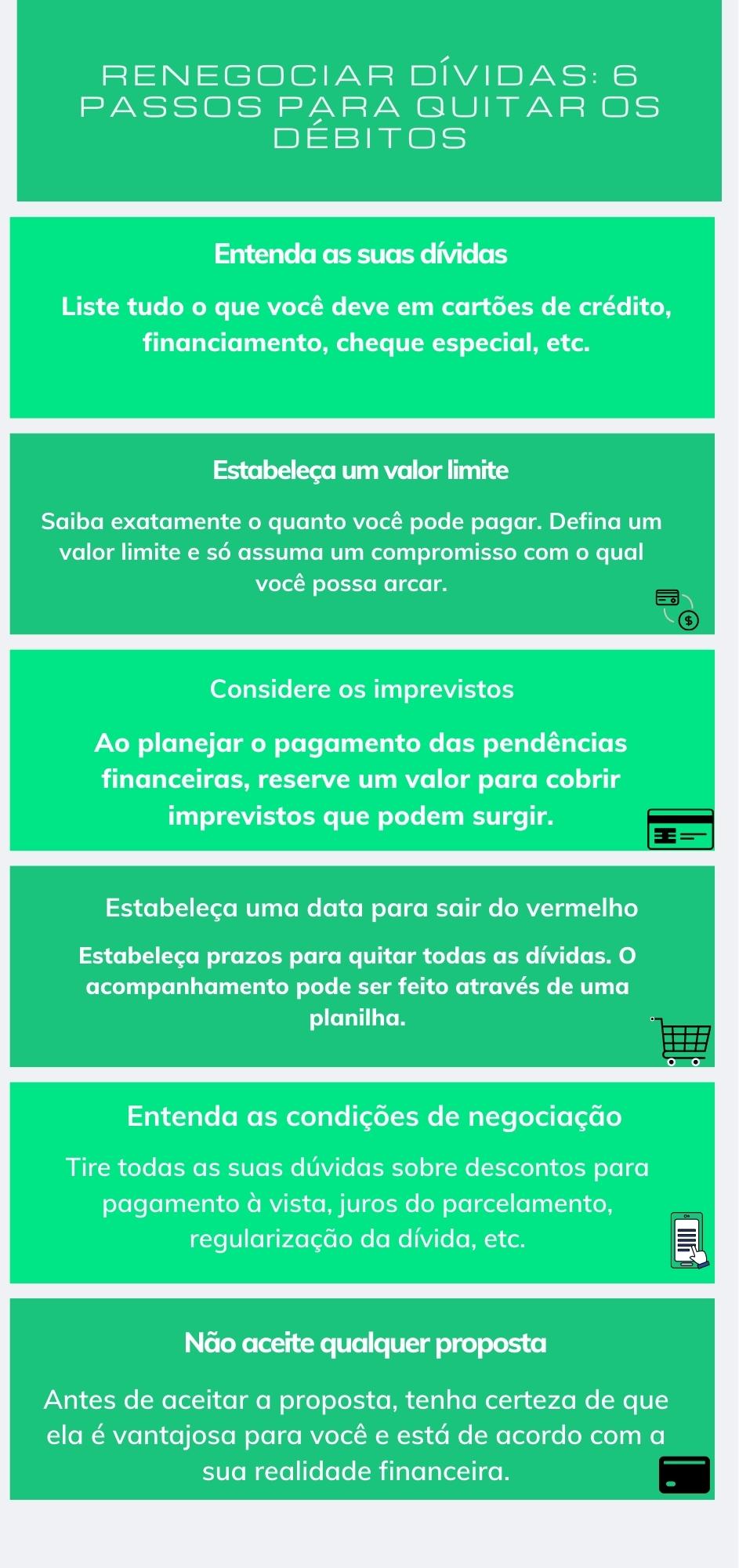
Getting out of over-indebtedness, although not easy, is possible.
Understand your debts and try to renegotiate them. However, before accepting an offer, make sure it is consistent with your financial situation.
Furthermore, not using your overdraft account helps a lot. The ideal is to cut out unnecessary purchases and make payments in cash to avoid new financial traps.