

Not sure how to calculate your 13th-month salary? Find out the exact amount you should receive!
Announcements
How to calculate the 13th salary is one of the most common questions among workers. After all, you know you'll receive it, but not the exact amount, right?
This benefit, so eagerly awaited by Brazilians at the end of the year, whether to pay off debts, buy gifts or invest, is a right for many workers.
If you want to learn more about the 13th salary and how to calculate it, keep reading! We'll explain everything you need to know.

Who is entitled to receive the 13th salary?
The benefit is offered to workers with formal employment contracts, rural workers, temporary workers, public servants, domestic workers, retirees and INSS pensioners.
In fact, after 15 days of service registered under the CLT regime, the worker is already entitled to the 13th salary.
Employees who are dismissed without just cause or whose contracts are terminated are also entitled to the benefit.
However, if the worker has more than 15 unjustified absences in a month of work, he loses the right to receive the 13th salary.
When should the 13th salary be paid?
The first installment of the 13th must have been paid by November 30th.
The second installment must be paid by December 20th.
If the 13th salary is not granted within these deadlines, the company is subject to paying a fine, which is approximately R$1,400,170 per employee who did not receive the benefit.
How to calculate the 13th salary?
Calculating your 13th-month salary is quite simple. Just apply the following formula:
Amount of remuneration / 12 months of the year X months worked in the period.
This way, you will have the proportional 13th salary amount.
To help you, we'll show you an example:
• Full salary (gross salary): R$ 2800
• Months worked: 8 months (over 12 months)
• 2800/12 = 233,33
• 233.33×8= 1866,66
This worker's 13th salary will be R$ 1866.66.
Remembering that this amount can be divided into two installments.

How is the 13th salary taxed?
There is no INSS tax on the first installment of the 13th salary.
Taxes (INSS and IRRF) are charged in the second installment. In other words, in the first installment (paid by the end of November), the worker receives the full amount.
The INSS discount can be 7.5%, 9%, 12% or 14% on the gross salary, following a progressive table.
| INSS progressive discount table | |
| Wage | INSS tax rate |
| Up to R$ 1,100.00 | 7,5% |
| From R$ 1,100.01 to R$ 2,203.48 | 9% |
| From R$ 2,203.49 to R$ 3,305.22 | 12% |
| From R$ 3,305.23 to R$ 6,433.57 | 14% |
What is deducted from the 13th salary?
Income Tax and INSS contributions are levied on the 13th salary.
Taxes, as you already know, are levied on the full amount of the 13th salary. In relation to FGTS, it is paid in both the first and second installments.
Calculation of the 13th salary with overtime
If you work overtime, you also need to enter that information into your manual count.
But after all, how to do this?
Basically, you must add up all the overtime hours worked up to October. This is the deadline, since the first installment is paid in November.
Let's assume that during all your months of work, you have worked 50 hours of overtime.
You must know what the cost of overtime worked is.
For a 220-hour monthly contract and a 2800 salary, the following calculation is made:
2800 / 220 = 12.72 (value of the hour worked).
Let's assume all your overtime was worked on weekdays. In this case, the law dictates that you should be paid an additional 50%.
Assuming that all overtime hours are 50%, we must take the value of the hour worked and divide it in half.
12,72 / 2 = 6,36
6,36 + 12,72= 19,08
Overtime value = 19.08
Since 50 hours of overtime were worked, do the following calculation:
50 x 19.08 = 954.5.
The result must be added to the gross salary. Therefore, it becomes: 2800 + 954 = 3754.
The number will be used to pay the first installment, which divided by 2, becomes = 1877.
Regarding the second installment, you must calculate the rates and calculate based on the INSS and IR discounts.
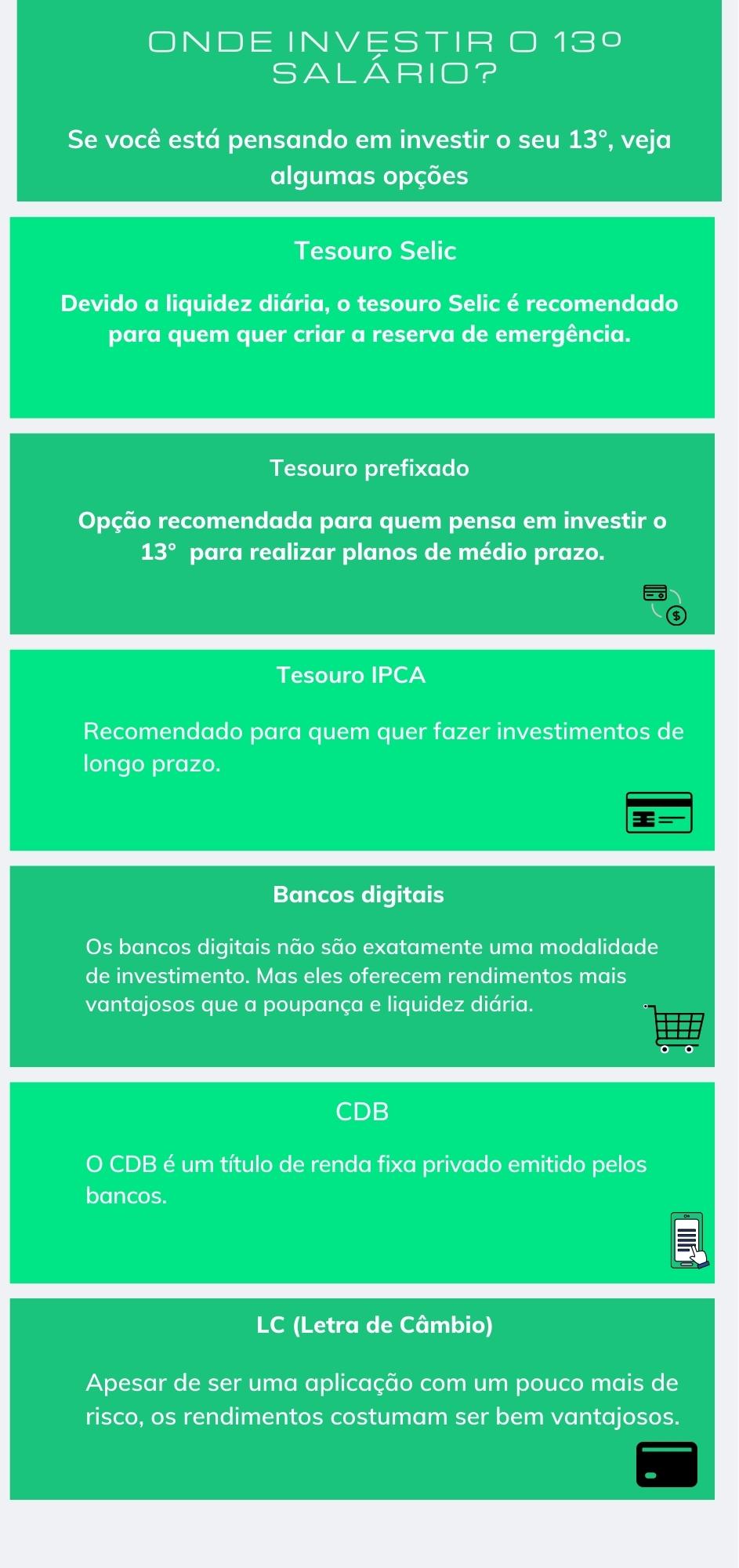
Use your 13th salary responsibly
At this time of year, it's normal to want to spend money on gifts, parties, trips, etc.
But remember that at the beginning of 2022, you'll have to pay some expenses, such as IPVA (vehicle tax), school supplies, among others.
So use yours 13th with responsibilityAnd if you have debts, ideally this money should be used to pay them off.
This way, you can start 2022 with much more peace of mind and financial organization.
What is the impact of the 13th salary on the Brazilian economy?
According to the Inter-Union Department of Statistics and Socioeconomic Studies (Dieese), more than 83 million Brazilians will benefit from the 13th in 2021.
The average payment will be R$ 2539.
More than R$232 billion will be injected into the Brazilian economy.
This amount will certainly make a difference in the lives of many families who were affected by the crisis and therefore went into debt during the year.
What happens if the company doesn't pay on time?
If the company does not pay the 13th salary by the stipulated date, the fine will be R$$ 170 per worker who did not receive the right.
In other words, the fine doubles in case of repeat offenses.
But it is important to remember that the amount of the fine is not paid to the worker but to the Ministry of Labor.
If you have not received your 13th salary, you must file a complaint with the Ministry of Labor, which will carry out an inspection.
Conclusion
Now you know who is entitled to the 13th salary and how the calculation should be done!
If you haven't received your thirteenth salary payment, look into your rights, as we're talking about something guaranteed by law for formally employed workers!